If you’re trying to figure out which side of MLS is actually stronger, don’t rush to a quick answer. When you follow the league closely each week, the gap between the two conferences often looks smaller than people expect. Form changes fast, and results don’t stay consistent for long. So it’s better to understand how the league is built, because the structure itself shapes what you’re seeing.
MLS Conference System
The system doesn’t treat all teams equally in terms of schedule, and that alone changes how standings and performances develop over time.
How the Eastern and Western Conferences Are Structured
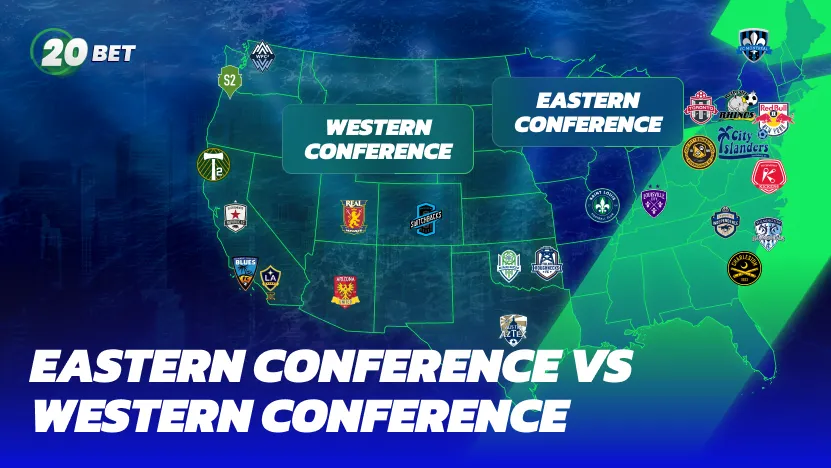
MLS splits its clubs into two conferences, each consisting of 15 teams. Most regular-season matches are played within a team’s own conference rather than against clubs from the opposite side.
Now, how many games are in an MLS season? Each team plays 34 matches during the regular season, but the schedule is not fully balanced. They play most of those games against teams from their own conference and only a few against the opposite side.
As a result, MLS effectively operates as two parallel competitions throughout much of the season. Teams build momentum against familiar opponents, and that can make a conference look stronger than it actually is.
It is also important to understand the match structure itself. For anyone wondering how long MLS games are, they follow the standard soccer format of 90 minutes plus stoppage time. However, across a long season, factors such as travel demands, squad rotation, and schedule density start to affect how those minutes are played.
Why MLS Uses a Conference Format
The conference system exists for practical reasons. MLS covers a massive area, so constant travel across the country would wear teams down quickly. By keeping most games inside each conference, the league reduces travel stress and keeps schedules manageable.
Continued MLS expansion has made conference balance even more important as the league keeps adding clubs across different regions.
The format also helps maintain parity across the league by keeping more teams competitive deeper into the season. They fight for position within their own group, which means more clubs stay in the race longer. You don’t see the table split early like in some European leagues.
At the same time, this creates confusion when you try to compare conferences directly. Since teams don’t play each other often, you don’t get a clear, consistent benchmark. A strong run in one conference doesn’t automatically mean the same level against the other.
Ultimately, the conference format itself makes direct comparisons between the two sides of MLS more difficult.
Eastern Conference Overview
Now that you understand how the system works, we can look at how the East actually performs in real competition.
Top Teams in the Eastern Conference
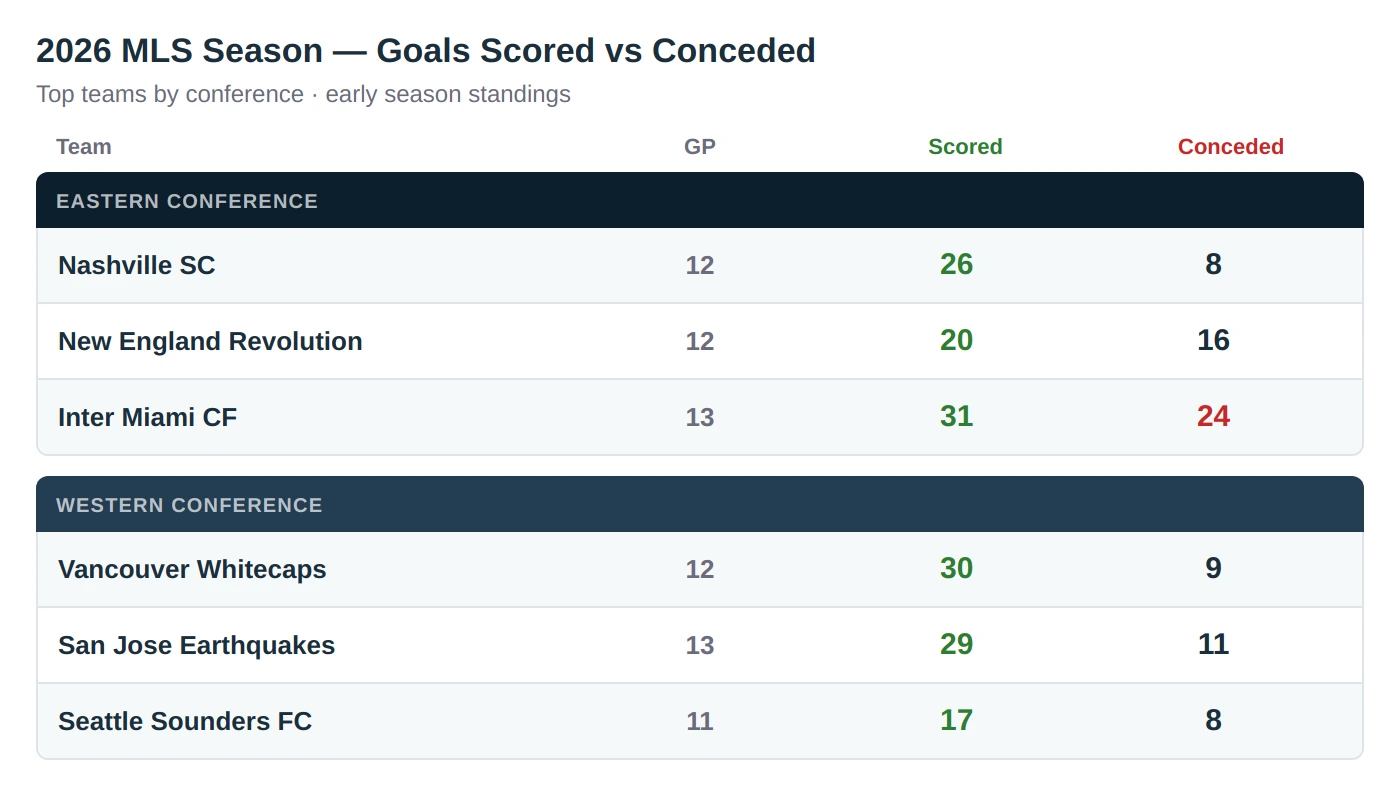
The current Eastern Conference standings remain tight early in the 2026 MLS season. Nashville SC lead with 27 points from 12 matches, while the New England Revolution and Inter Miami CF sit only a few points behind. Nashville’s +18 goal difference (26 scored, eight conceded) explains why the club sit at the top: they combine attacking output with one of the strongest defensive records in MLS. Miami, meanwhile, have scored 31 goals in 13 games but also allowed 24, creating far more open matches.
Historically, D.C. United and the Columbus Crew have been among the Eastern Conference’s most successful clubs. The former won four MLS Cups between 1996 and 2004, more than any other Eastern Conference side, while the latter added titles in 2008, 2020, and 2023.
Strengths of Eastern Teams
The East stands out more for balance than long-term dominance from one club. Across recent seasons, different Eastern Conference champions have lifted MLS Cup, including Toronto FC in 2017, Atlanta United in 2018, Columbus Crew in 2020 and 2023, and NYCFC in 2021. That rotation shows how difficult it is for one club to control the conference over multiple years.
Another strength is the influence of elite attacking players. While there is no official Eastern Conference MVP award, league MVP discussions regularly feature stars from the East because the conference produces more open matches and transition-heavy attacks.
Lionel Messi, who won the MLS Golden Boot last season, is one of the most obvious examples. All three of Inter Miami’s trophies have come after the star player’s arrival, including the 2025 MLS Cup, the 2024 Supporters’ Shield, and the 2023 Leagues Cup.
So when you watch Eastern teams, don’t just look at tactics. Pay attention to key players and how much space they get.
Potential Underdogs to Watch
This is where the East becomes unpredictable. Take FC Cincinnati — they’ve finished strong in recent seasons and even reached the top of the conference in 2023 before falling short in the final stages. Or look at the Philadelphia Union, who reached the MLS Cup in 2022 but didn’t convert it into a title.
These teams show a pattern: they stay competitive over a full season but don’t always finish the job. If you follow weekly MLS scores, you’ll notice many of their matches end with small margins — 1–0, 2–1, or late goals deciding outcomes. That’s a sign of a balanced league where even underdogs stay close to the top teams.
Western Conference Overview
The Western Conference has looked more controlled and defensively stable during the opening months of the 2026 MLS season. Matches are often tighter, scorelines stay lower, and the gap between teams depends on defensive consistency rather than pure attacking output.
Top Teams in the Western Conference
The Vancouver Whitecaps sit at the top of the Western Conference standings with 29 points from 12 matches. They’ve scored 30 goals and conceded only nine, giving them a +21 goal difference — the strongest defensive record among the conference leaders.
The San Jose Earthquakes are tied with the Caps on points and the number of wins, but because of their +18 goal difference, sit second in the table. Real Salt Lake and Seattle Sounders FC continue to hold strong playoff positions near the top of the table.
If you look at past Western Conference champions, a clear pattern appears. The LA Galaxy lead historically with multiple titles, while teams like Seattle and the Portland Timbers show up often in playoff runs. Look at goal difference, goals conceded, and how long a team stays near the top.
Key Strengths of Western Teams
Western Conference teams have generally relied more heavily on defensive structure during the opening months of the 2026 MLS season. The San Jose Earthquakes have conceded only 11 goals across their first 13 matches, while the Vancouver Whitecaps have allowed just nine in 12 games. The Seattle Sounders also remain among the strongest defensive teams near the top of the standings with only eight goals conceded in 11 matches.
That defensive consistency changes how Western Conference matches are played. Teams leave less space in transition, protect central areas more carefully, and rely more heavily on shape without the ball. As a result, many matches between Western Conference contenders are decided by small moments rather than constant end-to-end attacking sequences.
Individual moments still matter in tighter playoff games, which often turn on a single goal, defensive mistake, or key save. Recent Western Conference contenders have consistently built playoff runs around defensive control as much as attacking quality.
Another important factor is travel. Western Conference teams regularly cover longer distances during the season, which increases the importance of squad rotation, tempo control, and disciplined away performances.
Underdogs to Watch
Western Conference underdogs regularly keep matches close against stronger opponents. Teams like Houston Dynamo FC, the Colorado Rapids, or Austin FC may not sit at the top, but they regularly make games difficult. The Rapids also benefit from playing at altitude, which creates difficult away conditions for visiting teams.
When you check any MLS result, you’ll often see that top teams win by just one goal or drop points entirely. These underdogs defend deep, stay disciplined, and use moments like set pieces or counterattacks to stay in the game.
For example, even teams with a negative goal difference can take points at home against stronger opponents. One organized performance is enough.
So don’t judge Western underdogs by their position alone. Instead, watch how they perform against top teams.
Eastern vs Western: Key Differences in Playing Style
When you watch both conferences regularly, the contrast shows up clearly. Eastern matches feel quicker and more open, while Western games look more controlled and measured.
Offensive vs Defensive Trends
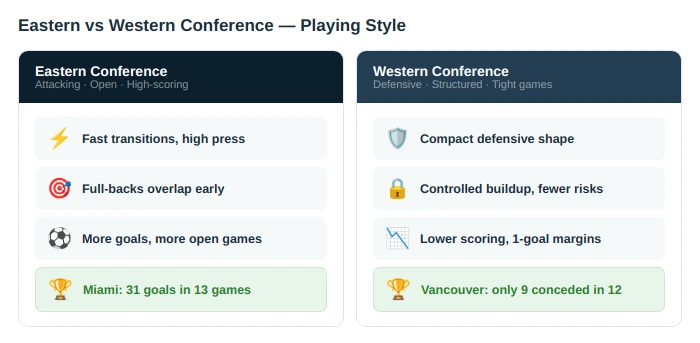
Focus first on how teams handle risk. Eastern sides like Inter Miami or Atlanta United FC often push numbers forward early. Full-backs overlap, midfielders step higher, and attacks develop fast. That creates more shots and higher-scoring games, but it also leaves space behind the defense.
Western teams take a more careful approach. Clubs such as Seattle Sounders FC or Real Salt Lake prioritize defensive shape. They defend with compact lines and move forward only when the structure stays intact.
You can see this clearly in the Western Conference finals, where games often end with one-goal margins. Teams don’t open up easily, and a single mistake can decide everything.
Tactical Approaches Across Conferences
Eastern Conference teams generally attack more directly and commit players forward earlier in possession. Inter Miami, for example, scored 79 goals during the 2024 MLS season, averaging 2.32 goals per match — one of the highest attacking outputs in the league. Miami and Atlanta United also pushed midfielders higher up the pitch during attacking phases, creating faster transitions and earlier entries into the final third.
Western Conference teams, by contrast, place greater emphasis on defensive shape and controlled buildup. Clubs like Seattle Sounders FC and Vancouver Whitecaps FC have consistently prioritized compact defensive positioning before committing numbers forward. That creates fewer open transitions and a slower overall match tempo compared to many Eastern Conference games.
That contrast becomes less extreme during the Eastern Conference finals, where playoff pressure forces attacking teams to take fewer risks in possession. The 2024 Eastern Conference Final between Orlando City SC and the New York Red Bulls finished 1–0 and was decided by a single second-half goal rather than open attacking sequences.
Statistical Comparison
The statistical gap between conferences appears most clearly in defensive records and match tempo. During the opening months of the 2026 MLS season, several Western Conference leaders combined strong goal differences with low goals-against totals, while Eastern Conference contenders were involved in more open, higher-scoring matches.
Inter-Conference Performance Comparison
When you compare East and West directly, the difference is about how those wins happen. Some seasons lean slightly toward one side, but the style behind the results stays quite consistent.
Head-to-Head Results
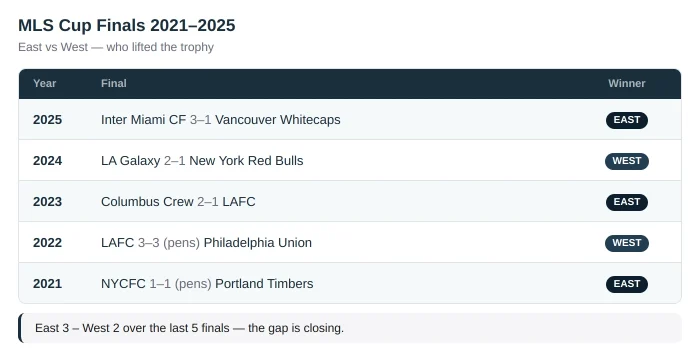
Recent MLS Cup finals show that both conferences trade control. The West has taken some of the latest titles, but the East keeps responding in the following seasons.
For example, Los Angeles FC from the West lifted the MLS Cup in 2022, then the Columbus Crew from the East answered in 2023. Not long after, the LA Galaxy added another title on the Western side. At the same time, conference finals also reflect this back-and-forth. In 2025, Inter Miami reached the final from the East with a very open 5–1 win over New York City FC, while the Vancouver Whitecaps handled San Diego FC 3–1 in the West with a more controlled performance.
Eastern teams tend to win with bigger scorelines, while Western teams usually close games with tighter margins. Over time, the West has also built stronger long-term winners — the LA Galaxy alone lead with multiple titles — while the East spreads success across different clubs like D.C. United, the Columbus Crew, and Toronto FC.
Points Per Game and Standings Impact
Looking at current form, Western teams at the top usually combine strong results with defensive control. The San Jose Earthquakes, for example, have been picking up points quickly while keeping goals conceded very low. The Vancouver Whitecaps follow a similar pattern — steady wins, positive goal difference, and fewer risky matches.
In the East, the picture is slightly different. Nashville SC sit at the top with solid balance, but just below them, teams like Inter Miami both score and concede a lot. That doesn’t stop them from staying competitive, but it shows how points are earned differently.
So even when both conferences produce similar standings, the path there is not the same.
Home vs Away Influence
Home and away splits reveal some of the sharpest contrasts in the current standings, and they don’t always follow the East/West pattern you might expect.
In the West, Vancouver’s 7-1-0 home record sits alongside a 2-0-2 away record, meaning they protect home ground effectively but play more conservatively on the road. Salt Lake show an even sharper split: 6-1-0 at home against 1-3-1 away. San Jose run almost the opposite way, posting a 5-1-1 road record compared to 4-1-1 at home — one of the more unusual profiles at the top of the table.
The East produces its own outlier. Inter Miami sit second in the conference with a 0-1-3 home record but 7-1-1 away — the best road record in the entire league at this point in the season. Nashville, by contrast, show the kind of consistent balance the West is usually credited for: 4-0-1 at home, 4-1-2 away, with a +18 goal difference that holds across both settings.
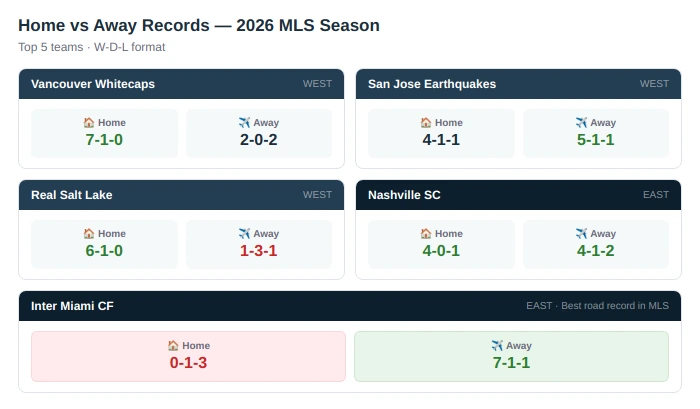
What the splits show is that home advantage in MLS is less predictable than in European leagues, and the East/West divide applies less to location than it does to style. A team like Miami can lead their conference while barely winning at home — something that rarely happens in a more home-dominant league.
Why the Western Conference Has Been Considered Stronger
For many years, the Western Conference built its reputation on results rather than perception. More MLS Cup winners and more consistent playoff runs came from the West, especially in the 2000s and 2010s.
Defensive Stability and Physical Play
Western teams have traditionally been harder to break down. Clubs like the LA Galaxy (early 2010s) and the Seattle Sounders (mid-late 2010s) relied on compact defensive shape and controlled tempo rather than open attacking play. Finals involving Western teams are often low-scoring. For example, Seattle won the MLS Cup on penalties after a goalless draw in 2016 and with a 3–1 victory in 2019, both built on defensive control rather than high-risk attacking.
Historical MLS Cup Success
The West has produced more MLS Cup-winning teams over time. The LA Galaxy alone have won six titles, and clubs like the Houston Dynamo, Seattle Sounders, Sporting Kansas City, and LAFC have all added to that total. Between 2009 and 2022, Western teams appeared in a large share of MLS Cup matches and often won them.
Consistency Across Teams
The Western Conference has not depended on one dominant team. Instead, multiple clubs cycle into contention.
For example:
- The LA Galaxy dominated the early 2010s
- The Seattle Sounders stayed competitive for nearly a decade
- LAFC have become a top team in recent seasons
- Seattle, Portland, and Real Salt Lake all reached finals in different years
This rotation keeps the overall level stable, with fewer weak playoff teams.
Is the Eastern Conference Catching Up?
In the past few seasons, the gap has clearly narrowed. The East now produces both strong regular-season teams and MLS Cup winners.
Recent Performance Trends
Eastern Conference MLS teams have started converting strong seasons into trophies. The Columbus Crew won the MLS Cup in both 2020 and 2023, while Atlanta United (2018) and NYCFC (2021) also lifted the trophy. More recently, FC Cincinnati won the Supporters’ Shield in 2023, and Inter Miami claimed it in 2024, showing that the East can dominate across a full season, not just short playoff runs.
Improved Depth and Competition
The Eastern Conference now has more teams consistently finishing with high point totals.
Looking at recent standings:
- Teams like Cincinnati, the Philadelphia Union, and the New England Revolution have posted 65–70+ point seasons
- Mid-table teams remain competitive, often separated by small margins
This means playoff qualification in the East is tighter and less predictable than before.
Shifts in Power Balance
The difference today is not about one conference being stronger overall, but about style and timing. The West still leans toward structure and defensive discipline. The East, on the other hand, has improved in attacking output and squad depth. Recent MLS Cup results and standings suggest the balance is now close, with both conferences capable of producing champions depending on the season.
Top Contenders for MLS Dominance
At this point, it makes sense to focus on teams that don’t just win matches but shape the season. Recent data already shows which clubs combine points, goal difference, and consistency.
Best Teams Overall
In the West, the Vancouver Whitecaps stand out immediately. 29 points from 12 matches, with 30 goals scored and only nine conceded, show a balanced profile.
Close behind, the San Jose Earthquakes maintain a similar attacking output while keeping a strong goal difference. Real Salt Lake and Seattle Sounders FC stay within reach, which means the top group in the West remains competitive.
In the East, Nashville SC lead with a different profile — 26 goals scored and only eight conceded. That’s one of the most balanced defensive records across both conferences. Then you have Inter Miami, where Lionel Messi changes how games unfold. Miami’s 31 goals show attacking strength, but their 24 goals conceded explain why their matches feel more open.
Dark Horses for MLS Cup
In the West, teams like Houston Dynamo FC or the Colorado Rapids don’t lead, but they stay competitive in most matches. They don’t concede heavily and often keep games within one goal. In the East, FC Cincinnati and the Philadelphia Union follow a similar pattern. Cincinnati have already shown in recent seasons that they can lead the conference, while Philadelphia have reached finals but struggled to convert them into titles.
What makes these teams dangerous is that they don’t need dominance to win. A short run of results, especially in playoffs, can push them ahead of stronger teams.
Who Is Stronger Right Now? Final Verdict
At the moment, the Western Conference looks stronger at the top. The Whitecaps opened the season with 29 points and a +21 goal difference, while the Earthquakes followed with 29 points from 13 games and only 11 goals conceded. Both teams have scored consistently without losing defensive control, which is why they’ve stayed near the top of the standings.
The Eastern Conference has been less stable overall. Nashville SC still put together one of the strongest starts in MLS with 27 points from 12 matches and just eight goals allowed, but the teams around them have looked more uneven defensively. Inter Miami, for example, scored 31 goals but also conceded 24, which explains why many Eastern Conference matches feel far more open.
Over a longer period, though, the gap between conferences is much smaller than it used to be. The Columbus Crew won the MLS Cup in 2020 and 2023, New York City FC lifted the trophy in 2021, and Atlanta United won it in 2018. The West answered through clubs like LAFC in 2022 and the LA Galaxy in 2024.
So the Western Conference currently looks more balanced at the top, especially defensively. But the idea that the East cannot compete anymore doesn’t really match recent MLS Cup results.
FAQ
Which MLS conference is historically stronger?
The Western Conference has often been viewed as stronger because more clubs consistently reached the MLS Cup and deep playoff stages during the 2000s and 2010s. Teams like the LA Galaxy, Seattle Sounders FC, and LAFC have also built longer periods of success across multiple seasons.
Why does the Western Conference often perform better?
It tends to rely on defensive structure and controlled play. Teams usually concede fewer goals and manage matches more carefully, which helps in long seasons and playoff formats.
Are Eastern Conference teams improving in recent seasons?
Yes. Teams like the Columbus Crew, FC Cincinnati, and Inter Miami have shown stronger results, better squad depth, and more consistent performances in recent seasons.
How do inter-conference games affect MLS standings?
Inter-conference matches are limited, but they still influence both the Eastern and Western Conference standings. Because clubs do not face opponents from the other conference frequently, even a small number of results can shape public perception of conference strength, despite the overall gap remaining relatively narrow.


Related Posts
See All-
 07/04/26
Can Vancouver Whitecaps Make a Deep MLS Playoff Run Or Even Win the Season?
After a historic 2025 MLS Cup run, the Vancouver Whitecaps are back. Explore their 2026 standings, key player updates and playoff predictions.
-
 12/05/26
Can Tata Martino Fix Atlanta United’s Collapse — or Is 2026 Already a Lost Season?
Atlanta United faces a historic collapse in 2026. Can Tata Martino fix the tactical gaps and defensive woes, or is the season already lost? Read our deep dive into the stats, squad imbalances, and playoff chances.
-
 22/05/26
Atlanta United World Cup Scheduling Nightmare: How Will 6 Away Games Shape Their 2026 Season?
The 2026 World Cup is taking over Atlanta. Here is how Atlanta United's MLS schedule adapts with an extended away game stretch this season.
-
 26/06/26
Choose a language Done Subscription successful! Stay tuned for our exciting news and offers.
Error We’re sorry, something went wrong. Please try again later.