When Tata Martino walked back into Atlanta United, it didn’t feel like an ordinary managerial appointment. It felt like a reset. The tactician who built the club’s identity, won an MLS Cup, and turned the Five Stripes into one of the most exciting teams in the league was back.
However, eight matches into 2026, the mood has changed. It looks like a squad that forgot how to win and, more importantly, forgot how to control games.
Atlanta United’s 2026 Struggles
You don’t need advanced metrics to understand where Atlanta stand right now. The results alone tell the story.
Current Form and Results Breakdown
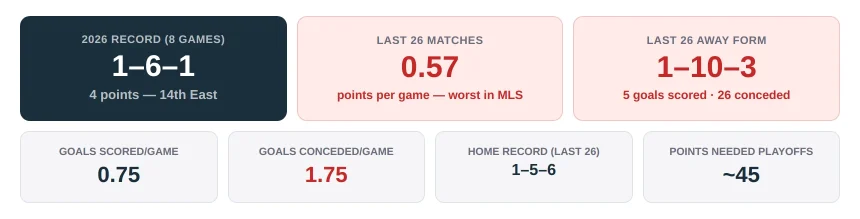
Check the Atlanta United standings, and you’ll see the problem immediately. After eight matches, they remain near the bottom of the Eastern Conference with a 1–6–1 record and only four points.
The Five Stripes concede early, chase games, and rarely look in control for a full 90 minutes. Their 3–2 loss to Real Salt Lake summed it up perfectly: moments of attacking quality, followed by defensive mistakes that undo everything. Their 2–0 defeat to Nashville felt even flatter.
Even the small positives don’t last. Atlanta ended a scoring drought of more than 200 minutes against Real Salt Lake but still left the match empty-handed.
Comparing 2026 to the 2025 Collapse
When you look back at recent Atlanta United games, the pattern becomes harder to ignore. Since late May 2025, the Five Stripes have won just two of their last 26 matches. During that stretch, they’ve recorded 15 losses, nine draws, and just 15 points from a possible 78.
Pick almost any Atlanta United game from this run, and you’ll see the same script. The analytics only confirm it.
Across the last 26 outings, the team have averaged just 0.57 points per game, the lowest return in MLS over that span. On the road, the numbers look even worse. They managed just one win in 14 matches (1–10–3), scoring just five goals while conceding 26.
Home performances have offered little relief. Atlanta posted a 1–5–6 record at Mercedes-Benz Stadium, scoring 17 goals but conceding 23.
What Went Wrong for Atlanta United
At some point, you stop blaming form and start looking at the structure. Atlanta’s problems aren’t random. They repeat themselves every week.
Offensive Inefficiency and Finishing Issues
Several Atlanta United players get involved in the build-up, but the final decision is often late or wrong.
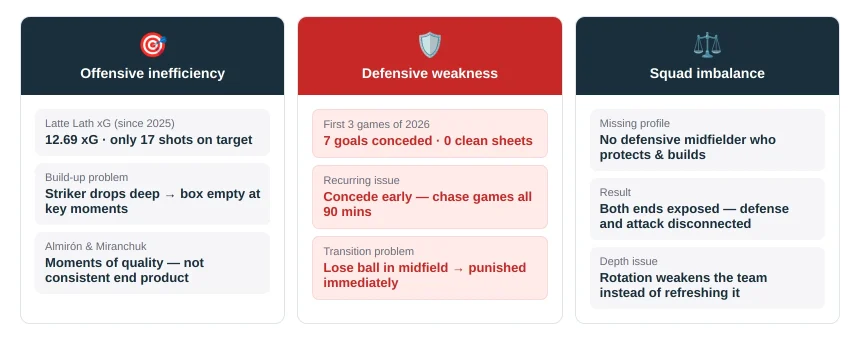
Emmanuel Latte Lath is the clearest case. His numbers don’t fully match his role. Since 2025, he’s produced 12.69 xG but managed only 17 shots on target. And then there’s positioning. When service doesn’t come, he drops deeper to find the ball. That sounds logical, but it leaves the box empty and removes the main target when Atlanta finally get forward.
Miguel Almirón brings energy but not enough end product. Miranchuk has moments, but not consistency. So the attack moves, but doesn’t finish.
Defensive Weaknesses and Goal Concessions
If the attack underdelivers, the defense usually makes the situation even worse. The 3–2 defeat to Real Salt Lake showed the same recurring issue: Atlanta lost the ball in midfield, left space in transition, and got punished quickly. The team continue to struggle against direct attacks, especially when opponents move the ball forward immediately after turnovers.
Even early in games, the structure often looks unstable. Against Real Salt Lake, Atlanta conceded twice within the first 30 minutes. That points less to isolated mistakes and more to problems with organization and spacing between the lines.
Across their opening three matches, Atlanta conceded seven goals and failed to keep a clean sheet. The problems also continue late into games, with the team regularly losing control in the second half once the pressure intensifies.
Squad Imbalance and Underperforming Signings
This is where everything connects. Watch a game like Toronto FC vs Atlanta United, and you’ll notice the gaps. The midfield neither consistently protects the back line nor effectively supports the attack. That leaves both ends exposed. The striker drops deep, the midfield stretches, and the back line gets isolated.
Atlanta don’t have a stable spine right now. Without that, even average opponents can dictate games, and the team end up reacting instead of leading.
Tata Martino’s Return: Expectations vs Reality
The idea behind the move was clear: bring back the coach who once made everything work. But soccer rarely repeats itself the same way twice.
Success During His First Atlanta United Spell
To understand the expectations, you have to look back at what the manager achieved during his first years in the league. Tata Martino’s MLS teams were known for aggressive attacking soccer, quick transitions, and a style that immediately made Atlanta United one of the league’s most entertaining clubs.
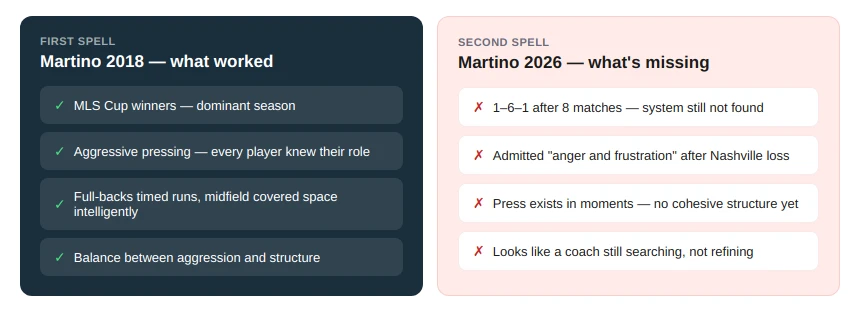
In 2018, the Five Stripes didn’t just win — they dominated. The squad scored freely, controlled tempo, and played with a clear identity built on pressing, quick transitions, and structured attacking patterns. They finished with one of the strongest records in the league and lifted the MLS Cup in front of their own fans.
More importantly, every player knew exactly what to do. Full-backs pushed at the right moments, midfielders covered space intelligently, and the front line pressed as a unit. That balance between aggression and structure made Atlanta one of the most complete sides in MLS at the time.
Why He Was Brought Back
Tata Martino and Atlanta United already had history together, and the club needed someone who understood both the pressure and the identity of the team. The Five Stripes needed more than a new voice. They needed a reset. The structure was fading, results kept slipping, and the squad often looked disconnected across the pitch.
Martino also understands the environment: the stadium, the expectations, and the pressure that comes with a big-market MLS club. That familiarity matters when results don’t come quickly.
The plan was simple: restore discipline, define roles clearly, and rebuild the core structure.
Early Signs from His Second Tenure
So far, the early signs have offered few definitive answers. After the loss to Nashville SC, comments from Tata Martino’s press conference made it clear he understands how serious the situation is. He admitted feeling “anger and frustration” after the match and said his focus was fully on finding a way forward for the team.
On the pitch, though, progress has been limited. The squad still concede too easily, especially in transition, and struggle to maintain control for a full 90 minutes. The structure that defined his first spell hasn’t fully returned yet.
There have been a few encouraging signs. Players like Matías Galarza have stepped up, and the team have shown brief attacking improvement after ending their goal drought. But these moments don’t last long enough to change results. Right now, Martino looks less like a coach refining a system and more like one still searching for it.
Tactical Issues Under Martino in 2026
The biggest issue is how the team connect their phases. Atlanta can build, press in moments, and even create chances. But those elements don’t come together within one cohesive structure.
Build-Up Play vs Final Third Problems
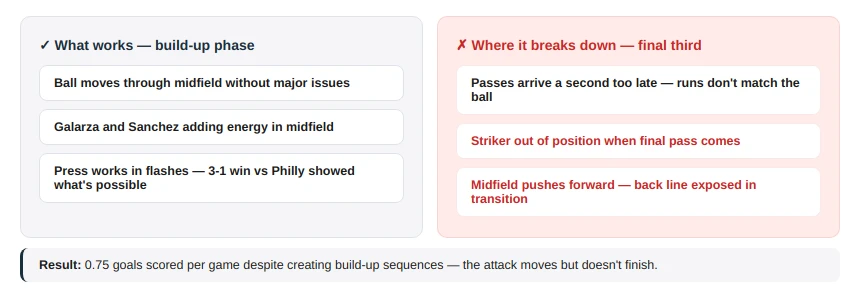
You can see it clearly in matches like Cincinnati vs Atlanta United. The team move the ball through midfield without major issues, but the attack slows down right before it matters.
Even in clashes where the Five Stripes control possession, they produce very little in the final third. Across the opening eight encounters of the 2026 season, Atlanta averaged just 0.75 goals per game despite still creating build-up sequences through midfield.
The issue is largely connected to timing. Passes arrive a second too late, runs don’t match the ball, and the striker is often out of position when the final pass comes.
Player Roles and System Fit
The structure also doesn’t fully suit the players. In the 2–0 defeat to Nashville SC, the contrast became obvious. Nashville stayed compact, protected central areas well, and pressed with clearly defined roles, while Atlanta often looked fluid but also far more exposed.
That imbalance continues to show in both performances and results. Through the opening eight fixtures of the season, they conceded 1.75 goals per game, while midfield protection remained inconsistent throughout matches. The striker often drops too deep to receive the ball, midfielders push forward without enough cover behind them, and the back line regularly faces direct runs in transition.
Lack of Consistency in Performances
Atlanta’s biggest problem is not the absence of good performances but the inability to reproduce them. The 3–1 win over CF Montréal on May 2 showed what the team can do when the press works properly, and transitions move quickly. The earlier result against Philadelphia showed similar improvement in attack and overall control.
But those performances fade quickly. Atlanta followed them with flat attacking displays like the 1–0 loss to Chicago, where they struggled to create clear chances. The 2–1 defeat to New England exposed the same defensive issues again, particularly after halftime.
The question is no longer whether Atlanta can play well — it’s whether the team can maintain that level consistently.
Can Atlanta United Turn the Season Around?
At this stage, the season doesn’t need a miracle. It needs structure, discipline, and better decision-making in key moments.
Potential Tactical Adjustments
The first adjustment has to come without the ball. Right now, Atlanta press inconsistently and leave space behind. A more compact setup could reduce some of the damage. They likely need to drop the defensive line slightly, press in more controlled moments, and close central spaces faster when possession is lost.
In possession, the team need faster decisions. Fewer touches, quicker shots, and more direct play in the final third would already improve efficiency.
Importance of Key Players Stepping Up
The system alone won’t solve Atlanta’s problems. The main attacking players also need to produce more consistently. Miguel Almirón still brings movement and energy, but the team need more direct output in goals and assists.
Miranchuk has to control tempo better and make cleaner final decisions, while Emmanuel Latte Lath needs to stay higher up the pitch instead of dropping too deep during build-up.
Right now, all three contribute in flashes, but Atlanta need them to decide matches more regularly.
Mid-Season Transfer Window Impact
Even with tactical changes, the squad still lacks balance. Atlanta remain short of a midfielder who can protect the defense, win physical duels, and move the ball forward cleanly under pressure. Without that profile, the team will continue to disconnect between phases.
There’s also a timing issue. The 2026 schedule includes disruptions related to the World Cup, including a stretch of six consecutive away matches that will test both depth and stability.
As a result, the transfer window could decide whether Atlanta stabilize their season or remain trapped in the same cycle.
External Factors Affecting the 2026 Season
Atlanta’s problems don’t exist in isolation. The calendar and the roster both make a quick turnaround harder.
Fixture Congestion and Scheduling Challenges
MLS doesn’t give long breaks. Atlanta have to correct issues while playing every few days. That matters because this team still need time on the training ground to fix spacing and decision-making.
The scheduling pattern also creates additional pressure, with several short turnarounds and stretches of back-to-back fixtures. When you’re already leaking goals and chasing games, that pace usually leads to repeated mistakes rather than improvement.
Impact of the 2026 FIFA World Cup
The 2026 World Cup affects the timing and rhythm of the MLS season. Some players leave for national teams, others return late, and the schedule adjusts around international windows.
For Atlanta, that means less continuity in team selection, fewer weeks with a complete squad available, and more difficulty building tactical consistency on the training ground. A club trying to rebuild structure usually needs stability. This season doesn’t offer much of it.
Squad Depth and Rotation Problems
Depth becomes a real issue when results are poor. Atlanta rely heavily on a small core. When players like Miguel Almirón or Alexey Miranchuk don’t deliver, there isn’t a reliable option available from the bench at the same level.
That creates two connected problems. The same players continue starting even when form drops, while rotation often weakens the team instead of refreshing it. In a long MLS season, that usually results in more dropped points.
Playoff Chances: Realistic or Gone?
At this point, the discussion shifts from “Can they improve?” to “Is there enough time left?”
Current Position in the Eastern Conference
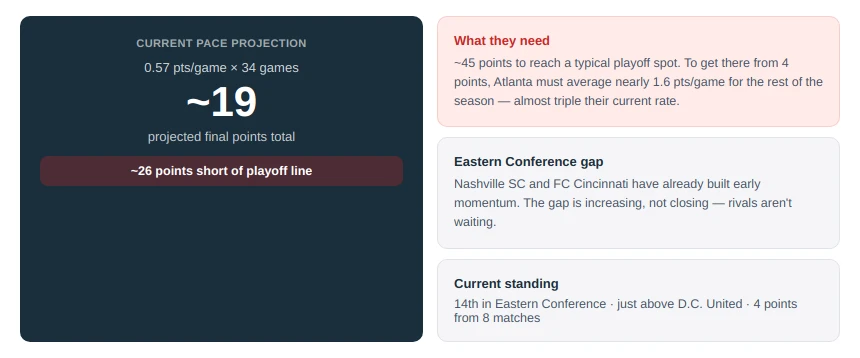
After eight matches, Atlanta sit 14th in the Eastern Conference, just above D.C. United, with a 1–6–1 record and only four points.
Points Needed for Qualification
Recent MLS seasons show a clear line: teams usually need around 45 points to secure a playoff spot. Atlanta average just 0.5 points per game this season and only 0.57 points per game across the last 26 matches.
At that pace, they would finish well below the playoff line. To recover, they would need to almost double their points rate over the remainder of the season.
Competitiveness of Rival Teams
The problem isn’t only Atlanta’s form but also the pace set by clubs above them in the Eastern Conference. Nashville SC built early momentum and established themselves near the top of the standings, while FC Cincinnati also collected important points during the opening stretch of the season. That has increased the pressure on the Five Stripes to recover quickly and made the playoff gap harder to close.
Upcoming fixtures like Atlanta United vs New York City could become important swing games in the playoff race if the team manage to stabilize their form.
Reasons for Optimism vs Reasons for Concern
Atlanta’s situation isn’t one-dimensional. You can point to real improvements, but you can also track the same problems repeating week after week. Both sides exist at the same time.
Signs of Improvement in Performances
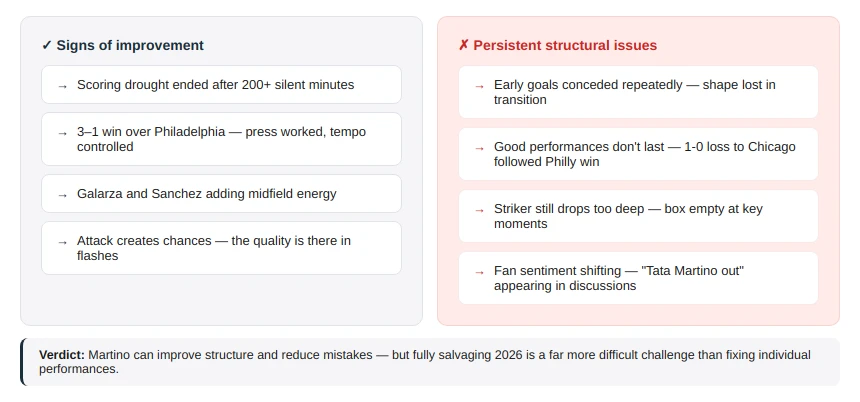
There are still a few positive signs beneath the disappointing results. Atlanta finally ended a scoring drought that had stretched across multiple matches, and the attack continues to create chances even during losses.
Players like Matías Galarza and Cooper Sanchez have added more energy in midfield, while encounters such as the 3–1 win over Philadelphia showed the team can still press effectively and control the tempo when the structure holds together.
Structural Issues That Persist
The larger concern is that the same structural mistakes continue to repeat. Atlanta conceded early goals against teams like Real Salt Lake, failed to keep clean sheets in the opening stretch of the season, and repeatedly struggled in transition after losing possession.
The attack also becomes less dangerous when the striker drops too deep, leaving the penalty area empty during key moments. Together, these problems point to poor spacing between the lines, inconsistent defensive shape, and a lack of control during decisive phases of matches.
Fan Sentiment and Club Pressure
The pressure surrounding the club is becoming increasingly visible. Attendance has started to decline, the atmosphere at home matches feels quieter than in previous seasons, and online reactions have shifted from patience toward frustration.
The phrase “Tata Martino out” has already started appearing in fan discussions. It’s early for that level of reaction, but it reflects the expectations attached to this club. Atlanta supporters don’t wait for long rebuilds. They expect visible progress quickly, especially with a coach who has already delivered a title.
Final Verdict: Can Martino Fix It in Time?
Ultimately, this comes down to pace rather than potential. Martino has fixed teams before, but those turnarounds still required time and a stable foundation. Atlanta don’t have either right now.
The results remain poor, the structure is inconsistent, and the schedule offers very few opportunities for recovery or tactical refinement. So the answer is complicated: yes, he can improve the team, but fully salvaging the 2026 season is a far more difficult challenge.
Short-Term Fix vs Long-Term Rebuild
In the short term, Martino can still improve the structure by tightening the defensive line, reducing transition space, and simplifying attacking decisions in the final third. Those changes could make Atlanta more competitive quickly.
The deeper issues, however, remain embedded within the squad itself. The Five Stripes still lack a reliable defensive anchor, consistent finishing from key attackers, and player roles that fully fit the system. Solving those problems requires transfer and contract decisions, training time, and long-term stability.
Most Likely Scenario for 2026
Atlanta’s numbers still leave very little room for optimism. The club have only four points from eight matches and have averaged just 0.57 points per game across the last 26 league encounters. To reach a typical playoff level (~45 points), they would need to perform like a top team for the remainder of the season. There’s little evidence of that level so far.
The most realistic improvement would probably be fewer defensive collapses, more balanced overall performances, and occasional wins instead of repeated losses.
However, that still may not be enough to rescue the season entirely. Even if performances improve, the most probable outcome appears to be a finish closer to lower mid-table or outside the playoff spots.
FAQ
Why are Atlanta United struggling in 2026?
Atlanta’s struggles come from several connected issues. The team continue to lose their defensive shape in transition, the attack creates chances without finishing consistently, and the midfield often fails to connect defensive and attacking phases properly.
Can Tata Martino turn the team around mid-season?
He can improve organization and reduce mistakes fairly quickly, which would likely lead to better performances.
But a full turnaround, from bottom of the table to a playoff contender, requires more than tactics. It needs consistent execution and possibly squad changes, which take longer.
What are Atlanta United’s chances of making the playoffs?
Right now, they are low. With four points from eight matches, Atlanta would need a sustained winning run to reach the typical playoff threshold. Based on current form, that level of consistency hasn’t appeared yet.
How does the 2026 schedule affect their season?
The schedule works against them.
- Frequent matches reduce training time
- International disruptions break rhythm
- Limited squad depth forces repeated lineups
For a team trying to fix structural problems, that combination slows progress and increases the likelihood of recurring mistakes.


Related Posts
See All-
 07/04/26
Can Vancouver Whitecaps Make a Deep MLS Playoff Run Or Even Win the Season?
After a historic 2025 MLS Cup run, the Vancouver Whitecaps are back. Explore their 2026 standings, key player updates and playoff predictions.
-
 26/06/26
 -
 22/05/26
Atlanta United World Cup Scheduling Nightmare: How Will 6 Away Games Shape Their 2026 Season?
The 2026 World Cup is taking over Atlanta. Here is how Atlanta United's MLS schedule adapts with an extended away game stretch this season.
-
 18/06/26
Why CF Montréal Keep Failing in MLS and What Must Be Changed
Discover why CF Montréal is trapped in an MLS crisis. From Joey Saputo’s ownership and lack of spending to coaching instability, here is what must change.
Choose a language Done Subscription successful! Stay tuned for our exciting news and offers.
Error We’re sorry, something went wrong. Please try again later.