Every NBA game produces a flood of numbers before tipoff: spreads, moneylines, totals, decimal odds, and American prices. Betting odds are just the price of a probability, and once you can translate that price, you can judge whether a wager is worth making. With betting odds explained in plain language, this guide covers how betting odds work across every format bettors encounter on 20Bet.
The Three Main Types of Basketball Betting Odds
Three formats dominate NBA betting odds globally. Each one expresses the same information differently. Understanding all three means you will never be confused by a price on platforms like 20Bet, regardless of the format displayed.
Decimal Odds Explained in Basketball Betting
Decimal betting odds are the simplest format to understand. The number represents your total return per $1 staked, including your original bet.
For example, during the 2026 NBA Playoffs, Boston closed at 1.12 against Philadelphia. A $100 bet on the Celtics returns $112. Philadelphia at 6.75 returns $675 on the same stake. The math is always your stake multiplied by the decimal price.
Fractional Odds Explained for Basketball Games
Fractional betting odds express profit relative to stake. A price of 5/2 means $5 profit for every $2 wagered, so $100 at 5/2 returns $250 profit plus your $100 stake. Favorites appear as fractions below 1/1 (e.g., 2/5). This format is more common in NBA futures and championship props.
American Odds Explained in NBA Betting
If you want to know how to read American odds, think in terms of $100. A negative number tells you how much you risk to win $100. A positive number tells you how much you profit from $100.
When San Antonio faced Miami on March 23, 2026, the Spurs sat at -186 and the Heat at +156. A $100 bet on Miami would win $156 in profit, for a total return of $256, while a wager on San Antonio would require $186 to win $100.
Understanding Point Spread Odds in Basketball
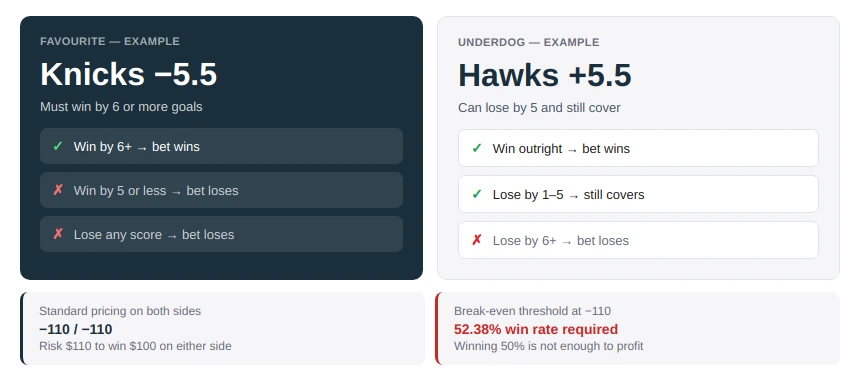
The point spread handicaps the favorite. In Game 1 between the Knicks and the Hawks during the 2026 playoffs, New York closed at -5.5 and Atlanta at +5.5. Betting on the Knicks means they must win by six or more, while a bet on the Hawks wins if they either win outright or lose by five or fewer. The half-point “hook” eliminates ties.
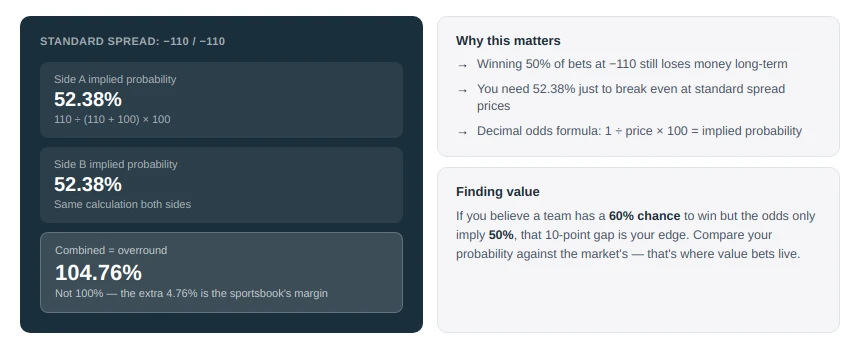
Point spread odds explained simply: both sides are typically priced at -110, meaning you risk $110 to win $100. That extra $10 is the sportsbook’s cut – the vig – built into both sides of the market. Because you’re risking more than you stand to win, you need to be right more than half the time just to break even: specifically, 52.38% of the time. That threshold is where any serious NBA betting strategy has to start.
Moneyline Odds in Basketball Betting
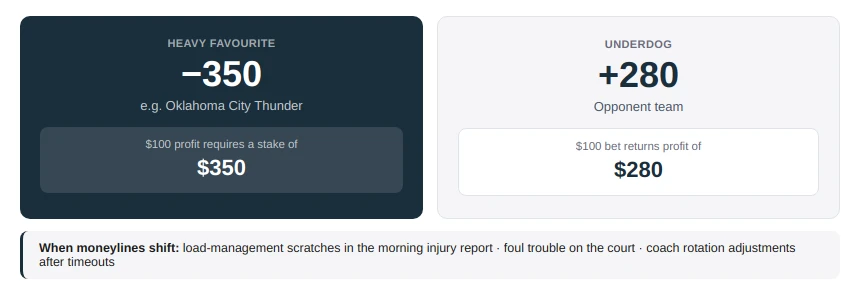
Moneyline betting strips away the spread entirely. You simply pick who wins. NBA moneyline odds reflect each team’s perceived probability. A heavy favorite like the Thunder at -350 means you risk $350 to win $100, while an underdog at +280 returns $280 in profit on a $100 bet.
Moneylines can shift when a starter moves to the bench for load management, a player picks up foul trouble on the court, or the coach adjusts the rotation after a timeout.
Over/Under (Totals) Odds in Basketball Games
The total is the projected combined score. In Game 1 between the Thunder and the Suns during the 2026 playoffs, the NBA over/under odds closed at 216.5. The game finished at 203, cashing the under.
Totals are shaped by pace, playbook tendencies, and whether a defense forces turnovers and steals for fast-break dunks, or grinds through zone sets built on rebounds and blocks. A team that generates assists in transition pushes the number higher. A press defense that creates jumpball situations and disrupts the dribble keeps it lower.
How to Calculate Potential Winnings From Basketball Odds
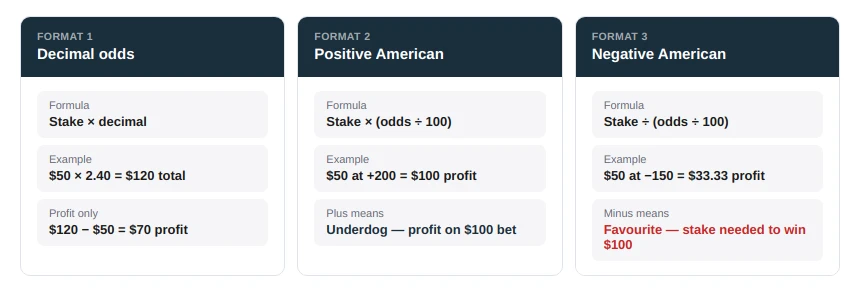
If you prefer not to calculate manually, free odds conversion calculators are available online and can handle all four formats instantly.
Implied Probability and What It Means for Basketball Bettors
Implied probability converts odds into a percentage, showing how likely the sportsbook believes an outcome is.
To find the implied probability, divide 1 by the decimal odds and multiply by 100. For example, odds of 1.85 translate to a 54.05% probability (1 / 1.85 * 100 = 54.05%).
On a standard -110/-110 spread, each side carries an implied probability of 52.38%. Combined, that equals 104.76%, not 100%. That extra 4.76% is the sportsbook’s overround, their built-in margin on the market.
Value emerges when your own read on a team’s win probability is higher than what the odds imply. If you believe a team has a 60% chance to win but the price only implies 50%, the line may offer value. ESPN’s NBA betting coverage regularly highlights these discrepancies during playoff series.
Why Basketball Betting Odds Move Before and During Games
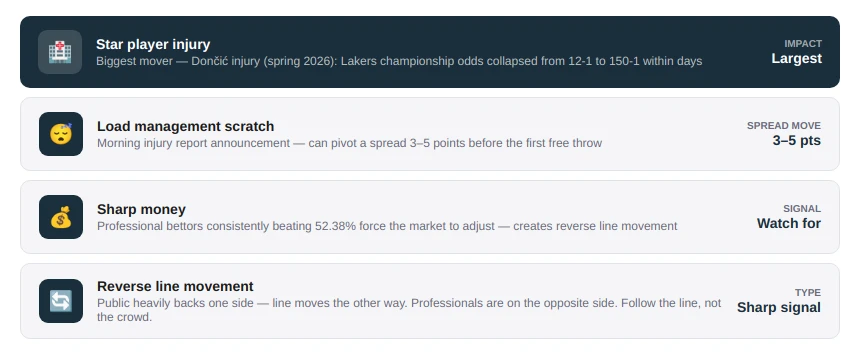
Injuries drive the biggest betting odds movements. When Luka Doncic went down in spring 2026, the Lakers’ championship odds collapsed from 12-1 to 150-1 within days.
Load-management scratches announced in the morning injury report can pivot a spread three to five points before the first free throw is taken.
Sharp bettors who consistently beat the 52.38% break-even threshold also influence the market. This can create reverse line movement, where the public heavily backs one side but the price shifts the other way.
Read Basketball Betting Odds: Top Tips for New Players
Start with decimal odds. They are the clearest format and are widely used across North America and Europe.
Convert every price into implied probability before wagering. Compare your own assessment against the market: if you think a team wins 60% of the time but the odds imply 50%, that gap is your edge.
Track lineup announcements and bench decisions during live games, as these can shift in-game NBA betting odds within seconds. On 20Bet, live lines update as the action unfolds. A coach pulling a starter after a third foul changes the shape of the game.
Finally, target two or three games per night, not 12. Discipline beats volume.
FAQ
What is the point spread in basketball betting?
The spread is a handicap applied to the favorite. If the Knicks are -5.5, they must win by six or more for the bet to cash. The underdog at +5.5 covers if they win outright or lose by five or fewer.
What is the difference between moneyline and spread odds?
Moneyline asks who wins. The spread asks who covers the handicap. A team can win the game and fail to cover the spread, or lose the game and still cover as the underdog.
How do decimal odds work in basketball betting?
Multiply your stake by the decimal number. A $100 bet at 1.90 returns $190 total ($90 profit). Any price below 2.00 represents a favorite. Decimal odds include your stake in the return.
Why do basketball betting odds change before a game starts?
Injuries, lineup changes, and betting volume are the main drivers. A star ruled out in a morning report can move a spread by four to six points. Sharp money from professional bettors forces further adjustments. Odds generally become more accurate closer to tipoff.


Related Posts
See All-
 09/05/25
The Rise of NBA Betting in Canada: What Bettors Need to Know
Learn how to bet on the NBA in Canada! Our guide covers the best betting markets, reading odds, live betting strategies, and top sportsbooks like 20Bet for Canadian bettors.
-
 05/12/25
Guide to Basketball Prop Bets in NBA Season 2025/26
Master NBA prop betting with our 2025/26 guide. Learn pro strategy on player props, SGP, line shopping, and how to use injury news & pace to find value.
-
 28/04/25
NHL Betting Canada: How to Bet on Hockey Games in Toronto, Montreal, Vancouver & More
Your ultimate guide to NHL betting in Canada! Learn about moneyline, puck line, prop bets, betting odds, strategies, legal aspects, and how to bet on hockey in Toronto, Montreal, Vancouver, and more.
-
 30/04/25
Sport Betting Canada: Top 5 Most Popular Sports to Bet on
Looking to bet on sports in Canada? Find out the most popular options, from NHL and CFL to NBA and MLB, and understand the factors driving the betting boom.
Choose a language Done Subscription successful! Stay tuned for our exciting news and offers.
Error We’re sorry, something went wrong. Please try again later.