
The 2026 season could become one of the strangest campaigns in the history of Atlanta United Football Club. The combination of the 2026 FIFA World Cup and MLS calendar adjustments has created a schedule unlike anything the club has faced before. With Atlanta United FC forced into a six-game away stretch split by the summer break, the pressure on coaching, recovery, travel logistics, and squad rotation will be intense.
The disruption goes beyond simple fixture changes. The team’s home ground, Mercedes-Benz Stadium, will host multiple World Cup matches in June and July 2026, forcing MLS to reshape its calendar around the tournament. For a club already chasing consistency in the Eastern Conference table, this period could define the entire season.
How the 2026 FIFA World Cup Disrupts MLS Scheduling
MLS had little choice but to redesign parts of the calendar once several league stadiums became World Cup venues. Atlanta United’s stadium will host multiple international matches, including a semifinal.
Fixture Adjustments and Calendar Congestion
The league introduced a long summer pause around the World Cup while trying to complete enough regular-season matches beforehand. Reports indicate that the Five Stripes will face a massive gap in home fixtures due to stadium availability.
That creates calendar congestion before the break. Instead of a balanced mix of home and away matches, Atlanta must navigate road-heavy weeks packed with travel, recovery sessions, tactical preparation, and limited training time. MLS already stretches squads because of distance and climate variation. Compressing fixtures increases the risk of injuries and tactical inconsistency.
Impact on Travel and Recovery Time
Away matches in MLS are different from most European leagues. Cross-country flights regularly exceed four or five hours, and teams deal with changing temperatures, altitude, and time zones. A trip from Atlanta to Portland or Vancouver is not comparable to a short domestic journey in Europe.
As a result, recovery windows shrink during congested schedules. Atlanta’s sports science staff will likely rotate training intensity throughout the six-game run to avoid physical breakdowns.
Atlanta United’s 6-Game Away Stretch
The unusual part of the 2026 Atlanta United FC schedule is not just the number of away fixtures, but their timing. The club reportedly faces six road matches split by the World Cup break while going months without regular action at home.
That creates major problems for rhythm and momentum. Home fixtures normally provide emotional energy, stable routines, and tactical control. Instead, Atlanta will spend weeks moving between airports, hotels, training facilities, and hostile stadiums.
The pressure also shifts onto the coaching staff. Rotation decisions become more important because one bad week on the road can quickly turn into a losing streak. In a league where playoff qualification margins are usually tight, dropped points during long away runs can damage Atlanta United’s standings by midseason.
Why Away Games Matter More in MLS
Home vs Away Performance Trends
Atlanta’s home record at Mercedes-Benz Stadium has consistently been stronger than their away form. The club’s supporters create one of the loudest environments in North American soccer, and attendance figures have consistently ranked among the league’s best.
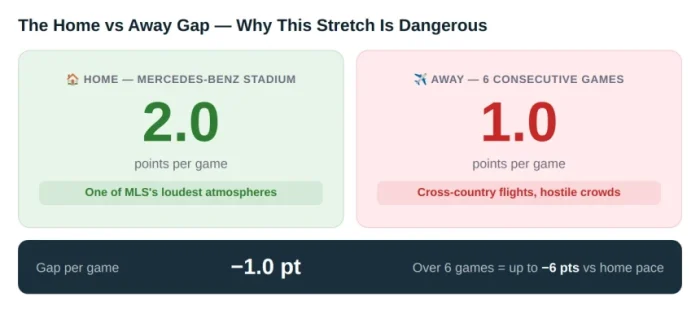
Away performances usually produce fewer goals, lower possession numbers, and reduced attacking output across MLS. That trend becomes even more important during six consecutive road-heavy weeks.
Psychological and Tactical Challenges
Long road stretches affect mentality as much as tactics. Players spend more time in hotels than at home, recovery routines change, and emotional fatigue builds quickly.
The psychological pressure increases after consecutive poor results. Confidence disappears faster away from home because players lose the support of local crowds and familiar surroundings. Coaching communication becomes critical during those periods.
Opponents also approach home matches aggressively in MLS. Teams press higher, attack earlier, and feed off supporter energy. Atlanta’s defensive organization will face constant pressure in difficult environments such as Nashville, Philadelphia, and New England.
Points Per Game Differences
The biggest danger is mathematical. MLS playoff races are usually decided by small point margins. A club averaging 2.0 points per game at home but only 1.0 away quickly loses ground in the table during road-heavy sequences.
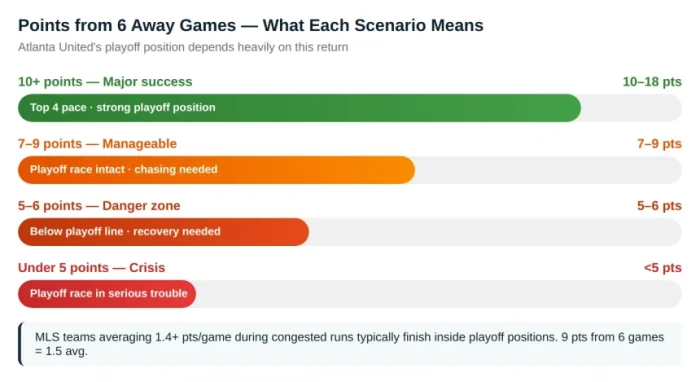
If Atlanta collect seven to nine points from six away fixtures, the schedule damage remains manageable. Anything lower could leave the club chasing the playoff line for the rest of the year.
Fixture Congestion and Player Fatigue
Decision-making quality drops during congested runs. Defenders react slower, midfield pressing weakens, and attacking players lose sharpness inside the penalty area.
Endurance across the full six-game run matters more than peak performance in any single fixture. Players who manage their output consistently will be more valuable than those who produce one standout away performance and then drop off.
MLS teams already rotate heavily because of summer temperatures and travel demands. Atlanta’s roster depth will become essential during this period. Substitutes and bench players may determine whether the team survives the stretch competitively.
Recovery management may also influence transfer strategy. Clubs entering the summer window often react aggressively if injuries pile up during congested periods. That could make the 2026 Atlanta United FC transfer market especially important.
Tactical Adjustments for a Road-Heavy Schedule
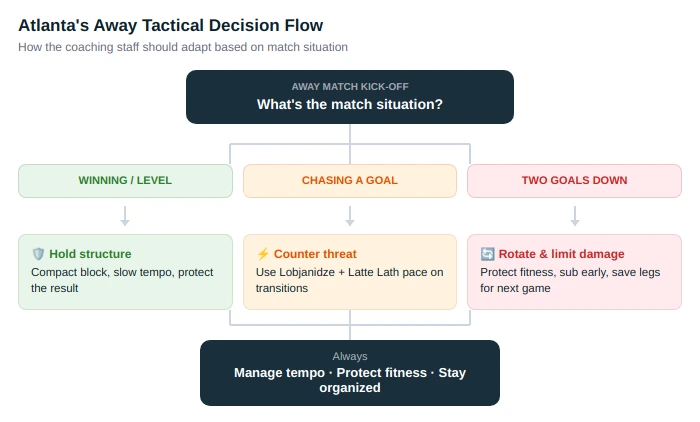
Atlanta’s coaching staff will likely be forced into clear tactical adjustments to survive the six-game away run. Match preparation will focus less on attacking dominance and more on efficiency, structure, and energy management across different stadium environments.
More Defensive Setups Away from Home
Atlanta may abandon aggressive attacking soccer in some away matches. Road games in MLS frequently reward defensive compactness rather than open possession play.
Expect tighter defensive blocks, more conservative fullback positioning, and lower-risk passing sequences. Protecting points may matter more than entertaining performances during this stretch.
Counterattacking Opportunities
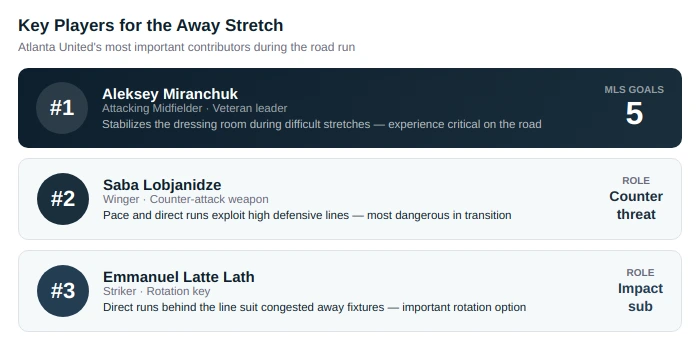
Counterattacking becomes more effective in away fixtures because opponents push higher in front of their supporters. The Five Stripes can exploit that space using their pace and direct transitions. Atlanta United players like Saba Lobjanidze and Emmanuel Latte Lath are well suited for this approach. Both rely on pace and direct runs, which become more effective against high defensive lines often used by MLS home teams.
Managing Game Tempo and Possession
Possession alone does not guarantee results in difficult away matches. Atlanta have averaged around 54% possession during the 2026 season, but controlling tempo matters more than controlling the ball.
Slowing the pace of the game allows players to conserve energy during heavy travel periods while reducing defensive exposure. Structured possession phases can also limit transitions from opponents, which are one of the biggest threats in MLS away fixtures.
Key Players Who Must Step Up
Leaders in Difficult Away Matches
Veteran leadership becomes critical during road-heavy periods. Experienced players stabilize dressing rooms after losses and help younger teammates handle pressure.
Among Atlanta United’s top scorers in 2026, Aleksey Miranchuk leads with five MLS goals as of May 13, 2026. Saba Lobjanidze is another player capable of leading the team during the difficult period.
Every Atlanta United goal during the away stretch will carry extra weight — with no home fixtures to recover dropped points, contributions from Miranchuk, Lobjanidze, and Latte Lath become directly tied to playoff positioning.
Importance of Defensive Organization
Strong defense travels better than attacking flair. For example, Nashville, who are top of the table as of May 2025, concede the fewest goals per road game (0.29). Atlanta cannot afford structural mistakes during six consecutive away fixtures.
Set-piece defending, defensive transitions, and compact spacing between midfield and defense will become essential. MLS teams punish poor organization quickly, especially at home. Conceding early goals on the road would force Atlanta into exhausting chasing situations repeatedly.
Role of Bench and Rotation Players
Rotation players may quietly become the most important part of the roster. Heavy schedules increase minutes for substitutes, academy graduates, and squad depth pieces.
Fresh legs matter late in away matches. MLS rules around substitutions already encourage tactical rotation, and Atlanta will likely rely heavily on bench contributions during this stretch.
How This Stretch Could Define the Season
Best-Case Scenario: Points Accumulation
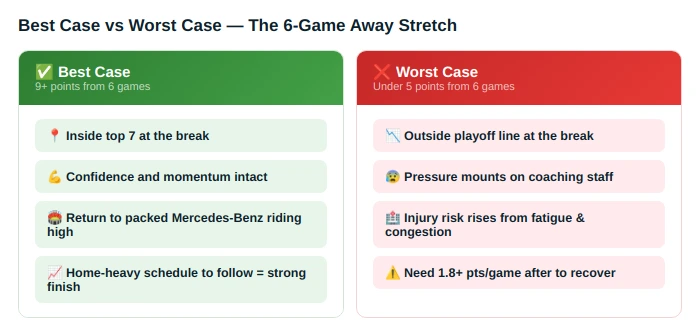
The best-case scenario is built around consistency rather than dominance. If Atlanta average at least 1.5 points per game across the six away fixtures, they would collect roughly nine points, which would keep them on playoff pace.
That level of performance usually places teams within the top seven by midseason. More importantly, avoiding consecutive defeats helps preserve confidence and stability within the squad.
Worst-Case Scenario: Losing Streak Impact
The worst-case scenario involves a collapse in form during the road run. If Atlanta collect fewer than five points from six matches, they risk dropping below the playoff line after the World Cup break.
In recent MLS seasons, teams outside the top nine by midyear face a steep climb to qualification, often needing over 1.8 points per game afterwards to recover. A losing streak would also increase pressure on squad rotation, raise fatigue levels, and expose defensive weaknesses under constant stress.
Momentum Heading Into Home Fixtures
If Atlanta return home after surviving the difficult run competitively, the club could build major momentum inside a packed Mercedes-Benz Stadium. Home fixtures after months away may feel emotionally charged for supporters and players alike.
Playoff Implications for Atlanta United
Points Needed During the Away Run
Eastern Conference playoff races rarely allow extended losing streaks. Atlanta probably need at least seven to nine points from the six away fixtures to remain in a healthy position. Anything above 10 points would represent a major success considering the schedule difficulty.
Competition in the Eastern Conference
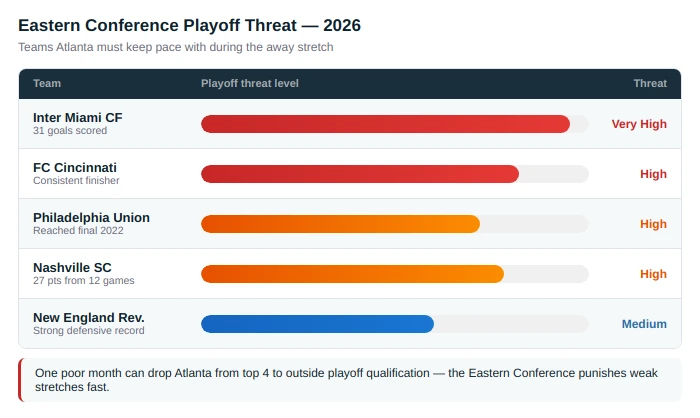
The Eastern Conference remains brutally competitive. Clubs like Inter Miami, Cincinnati, and the Philadelphia Union consistently punish weak stretches. One poor month can drop a club from the top four to outside playoff qualification.
Margin for Error in 2026
The unusual schedule means Atlanta cannot afford slow starts or tactical confusion. Early dropped points carry more weight because the fixture list becomes unbalanced around the World Cup pause.
Is it Crisis or Opportunity?
Factors That Could Turn It Around
The schedule creates clear risks, but it also presents a measurable opportunity. MLS seasons often reward teams that survive difficult stretches, with clubs collecting over 1.4 points per game during congested runs typically finishing inside the playoff positions. If Atlanta maintain defensive stability and collect consistent points on the road, they can gain an advantage over direct Eastern Conference rivals.
Long-Term Impact on Atlanta United’s Season
This period will shape the trajectory of Atlanta United’s 2026 season. A disciplined run could position the club inside the playoff zone with a favorable home-heavy schedule to follow. Historically, MLS teams that secure at least 20-22 points in the first third of the season remain strong candidates for qualification.
Failure to manage the away run would shift the focus toward recovery rather than progression. That scenario forces the team into high-pressure matches later in the season, where margins for error shrink significantly. The difference between those outcomes will come down to execution during these six matches.
FAQ
Why do Atlanta United have so many away games in 2026?
Atlanta United’s schedule is heavily affected by the 2026 FIFA World Cup, as Mercedes-Benz Stadium will host multiple matches. MLS adjusted the calendar to accommodate the tournament, which resulted in a long stretch of Atlanta United’s away fixtures.
How does the World Cup affect MLS teams?
The World Cup impacts stadium availability, travel logistics, and fixture planning. Teams sharing venues with tournament matches face congested schedules, longer away runs, and increased reliance on squad rotation and recovery management.
Can teams succeed during long away stretches?
Yes, but success depends on defensive organization, efficient counterattacking, and disciplined game management. MLS teams that average at least 1.3-1.5 points per game away from home usually remain competitive in the playoff race.
Will this schedule hurt Atlanta United’s playoff chances?
It increases the difficulty but does not eliminate their chances. If Atlanta collect at least 7-9 points during the away stretch, they can remain within reach of the playoff positions in the Eastern Conference standings.
How long do Atlanta United games last?
MLS matches run 90 minutes plus stoppage time. Over six consecutive away fixtures, that adds up to over 540 minutes of competitive play.


Related Posts
See All-
 07/04/26
Can Vancouver Whitecaps Make a Deep MLS Playoff Run Or Even Win the Season?
After a historic 2025 MLS Cup run, the Vancouver Whitecaps are back. Explore their 2026 standings, key player updates and playoff predictions.
-
 12/05/26
Can Tata Martino Fix Atlanta United’s Collapse — or Is 2026 Already a Lost Season?
Atlanta United faces a historic collapse in 2026. Can Tata Martino fix the tactical gaps and defensive woes, or is the season already lost? Read our deep dive into the stats, squad imbalances, and playoff chances.
-
 26/06/26
 -
 22/04/26
What Went Wrong for the LA Galaxy — And How They Fixed It
How did the 2024 MLS Cup winners fall to last place? Discover the injuries, salary cap issues, and tactical shifts that defined the LA Galaxy.
Choose a language Done Subscription successful! Stay tuned for our exciting news and offers.
Error We’re sorry, something went wrong. Please try again later.