
Hockey betting odds tell you two things: which team the sportsbook expects to win and how much you stand to collect if your bet hits. Every number next to a team name reflects a calculated probability with a built-in profit margin for the book. This guide walks through every format you’ll encounter on 20Bet.
What Hockey Betting Odds Represent
Oddsmakers build NHL betting odds from power ratings, goals scored and allowed, goalie save percentages, and powerplay efficiency. Advanced stats like expected goals (xG) feed into the opening line. Once it goes live, betting action from sharp bettors and the general public shifts it further.
Hockey stands apart because roughly half of all NHL games are decided by a single goal, and around 21-24% have reached overtime or a shootout over the past nine seasons. That tight scoring across the rink is why the puck line stays fixed at 1.5 goals rather than moving game to game like an NFL spread.

The Three Main Types of Hockey Betting Odds
Three formats display the same information differently. Knowing all three helps you compare betting odds for ice hockey across sportsbooks like 20Bet.
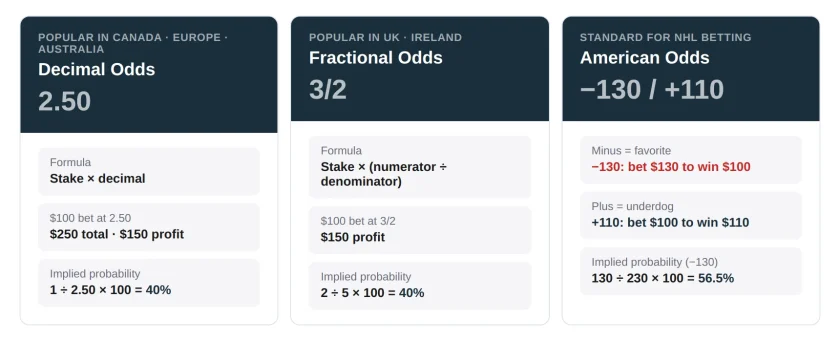
Decimal Odds Explained in NHL Betting
Decimal odds are popular in Canada, Europe, and Australia. To calculate your total return, multiply your stake by the decimal number. For example, a $100 bet at 2.50 returns $250 ($150 profit plus your original $100).
To find implied probability, divide 1 by the decimal and multiply by 100. In this case, 2.50 converts to a 40% implied probability.
Fractional Odds Explained in Hockey Betting
Fractional odds are common in the UK and Ireland. The first number shows profit relative to the second. How to read fractional odds: 3/2 means you earn $3 for every $2 you risk. A $100 bet at 3/2 returns $150 in profit.
To calculate implied probability, divide the denominator by the sum of both numbers and multiply by 100. That’s 2 / 5 x 100 = 40%.
American Odds Explained for NHL Games
American is the standard format for NHL betting odds. Positive numbers show profit on a $100 bet. Negative numbers show how much you need to stake to win $100.
How do American odds work? If the Bruins are -130 and the Canadiens are +110, you’d need to bet $130 on Boston to win $100 or bet $100 on Montreal to win $110. The minus sign marks the favorite, while the plus sign marks the underdog.
Understanding the Puck Line and Its Odds
What is the puck line? It’s hockey’s point spread, fixed at 1.5 goals. The favorite at -1.5 must win by two or more. The underdog at +1.5 can lose by one goal and still cover.
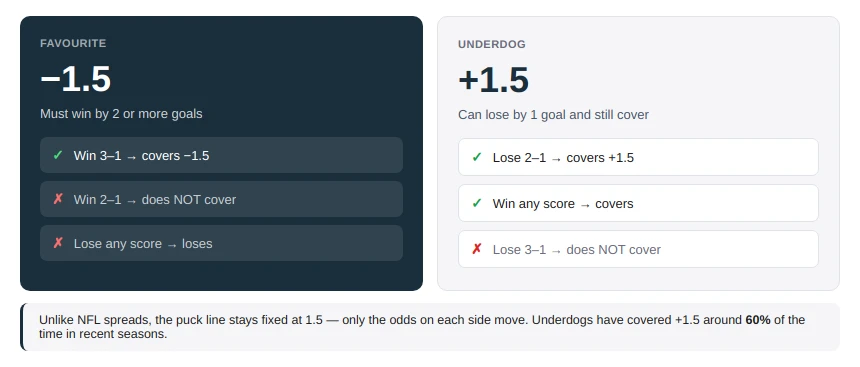
Late-game situations often decide puck line outcomes, especially when a forward scores into an empty net in the final moments. A defenseman’s slapshot from the point that deflects in still counts as a goal for puck line purposes.
Underdogs have covered the +1.5 puck line around 60% of the time in recent seasons.
Moneyline Odds in Hockey Betting
The moneyline is a bet on which team wins. Understanding hockey odds when betting the moneyline starts with one rule: overtime and shootout results count. Some books offer a 60-minute line graded after regulation only, where a tie is a possible outcome.
Underdogs win between 40 and 48% of games outright, a higher rate than in the NBA or NFL. That parity is what draws bettors to moneyline hockey.
Over/Under (Totals) Odds in NHL Games
NHL over/under bets ask whether both teams will combine for more or fewer goals than the posted total. Most lines sit between 5.5 and 6.5. Overtime goals count, and even the shootout-winning goal counts because the final score awards one extra goal to the winner. Juice usually sits near -110 on both sides. At -110 on a six-goal total, a $110 bet on the over returns $100 profit if both teams combine for seven or more goals.
How to Calculate Potential Winnings From Hockey Odds
Once you know which odds format you’re looking at, working out your potential payout takes one quick calculation. Below is the same $100 bet run through all three formats so you can see exactly where profit and total return differ.
- Decimal: $100 x 2.50 = $250 total return.
- Fractional: $100 x (3/2) = $150 profit.
- American positive: $100 x (150/100) = $150 profit.
- American negative: $100 x (100/130) = $76.92 profit.
Implied Probability and What It Means for Hockey Bettors
Implied probability converts betting odds into a percentage that reflects how likely the sportsbook thinks each outcome is.
Take odds of -150. Divide 150 by 250, multiply by 100, and you get 60% (150 ÷ 250 × 100 = 60%). Do the same with +130, and you get 43.5% (100 ÷ 230 × 100 = 43.5%).
Add both sides together, and you land at 103.5%, not 100%. That extra 3.5% is the vig, the sportsbook’s built-in cut on every market.
The vig is why you can’t just win half your bets and expect to profit. At standard -110 odds, you need to hit 52.4% to break even.
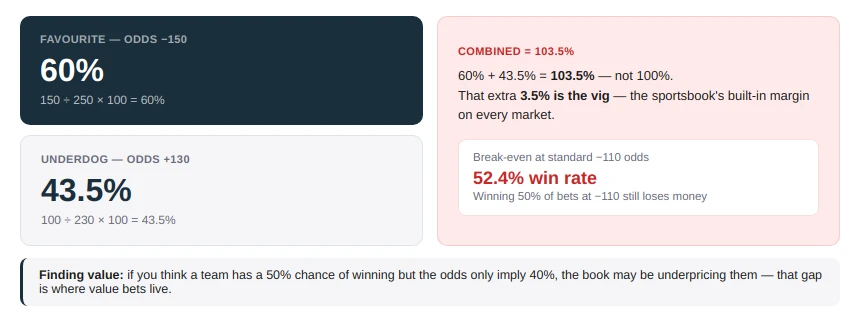
But implied probability also helps you find edges. Say you think a team has a 50% chance of winning, and the odds only imply 40%. The book may be underpricing them, and that gap between your number and theirs is where value bets live.
Why Hockey Betting Odds Change Before and During Games
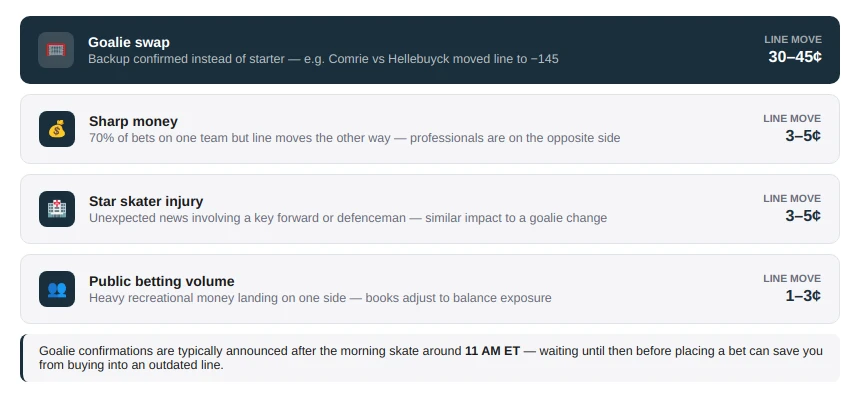
Goalie confirmations can move an NHL line, but usually only in more extreme situations. For example, when the Jets announced backup Eric Comrie would start instead of Connor Hellebuyck, the Lightning moved from a pick’em to -145 favorites. Still, oddsmakers say starting goalies are typically worth only about 3% to 5% of implied probability, and unexpected injury news involving a star skater can shift a line by a similar amount.
Live hockey betting odds change with every goal, every penalty call, and every faceoff that shifts momentum. A score late in the third moves the line harder than one in the first period. Sharp money matters too. If 70% of bets land on one team but the line moves the other way, professionals are on the opposite side.
Read Hockey Betting Odds: Top Tips for New Players
Want to learn how to read hockey bets properly? Here’s what to have in mind:
- Compare odds across multiple books. The difference between -130 and -120 adds up over a full season.
- Wait for goalie confirmations – typically announced after the morning skate around 11 AM ET – before placing a bet.
- Don’t let a big fight or a controversial call tilt your in-game betting. Line moves after emotional moments often overcorrect and create short-term value on the other side.
- Start with moneyline bets before moving to puck lines. 20Bet lists both on every NHL match page, making it easy to compare.
- Learn to calculate implied probability so you can spot when a line doesn’t match your read on a game.
- Always check whether overtime and shootout results affect your specific bet type before the arena lights go on.
Responsible Gaming
Betting on hockey should be fun, not stressful. Before placing any wager, set a budget you’re comfortable losing entirely and stick to it. Never chase losses by increasing your stakes after a bad night, and don’t bet money you need for rent, bills, or groceries.
A few practical guidelines to keep things in check:
- Decide your bankroll for the week or month before the first puck drops. When it’s gone, you’re done.
- Avoid betting under the influence of alcohol or when you’re emotionally invested in a specific outcome.
- Take breaks. If you’re placing bets on every game, every night, that’s a sign to step back and reassess.
- Winning streaks end. Don’t let a hot week convince you to double your usual stake.
If gambling stops feeling like entertainment and starts feeling like a problem, help is available. The National Council on Problem Gambling offers a confidential helpline at 1-800-522-4700 and live chat at ncpgambling.org. In Canada, visit responsiblegambling.org for province-specific resources.
FAQ
What is the puck line in hockey betting?
The puck line is a 1.5-goal spread. The favorite at -1.5 needs to win by two or more goals, while the underdog at +1.5 can lose by one, and the bet still pays. Unlike NFL spreads, the number stays fixed. Only the odds on each side move.
What is the difference between moneyline and puck line odds?
The moneyline is a straight bet on which team wins. The puck line adds a 1.5-goal handicap. A team can lose 3-2 and still cover the +1.5 puck line, but that same score loses a moneyline bet. Favorites get better payouts on the puck line because winning by two goals in a tight game is harder.
How do decimal odds show potential winnings in hockey betting?
Multiply your stake by the decimal. A $50 bet at 3.00 returns $150 total ($100 profit plus your $50 back). The higher the decimal, the less likely the sportsbook considers that outcome.
Why do NHL betting odds move before a game starts?
Four factors: goalie confirmations (the biggest mover, worth 30 to 45 cents of line movement), injury updates, public betting volume landing on one side, and sharp bettors placing large wagers that signal informed positions. For outdoor games like the Winter Classic, weather and ice conditions also play a role.


Related Posts
See All-
 26/05/25
Goal Markets Guide: BTTS, Over/Under & Clean Sheet Predictions
Discover profitable soccer betting strategies beyond match results. Our guide breaks down both teams to score, over under betting, and clean sheet bets for smarter wagering.
-
 03/06/25
Parlay Betting Canada: Top Soccer Picks of the Week: 20Bet’s Winning Combos
Master parlay soccer betting in Canada with our top picks and betting strategies from 20Bet. Learn how do parlays work, manage risk, and build smart winning combos for Canadian soccer fans.
-
 01/07/25
The Truth About Tipsters: Are Any of Them Actually Profitable?
Can sports tipsters provide long-term value? Article breaks down the tipster business model, uncovers real profitability statistics, and highlights red flags to avoid.
-
 03/10/25
Small Markets, Real Edges: Corners, Cards, and Props
Reveal hidden value in sports betting with our expert guide to corners, cards, and player props. Learn strategies for leveraging small markets and finding pricing gaps on 20Bet and other bookmakers.
Choose a language Done Subscription successful! Stay tuned for our exciting news and offers.
Error We’re sorry, something went wrong. Please try again later.