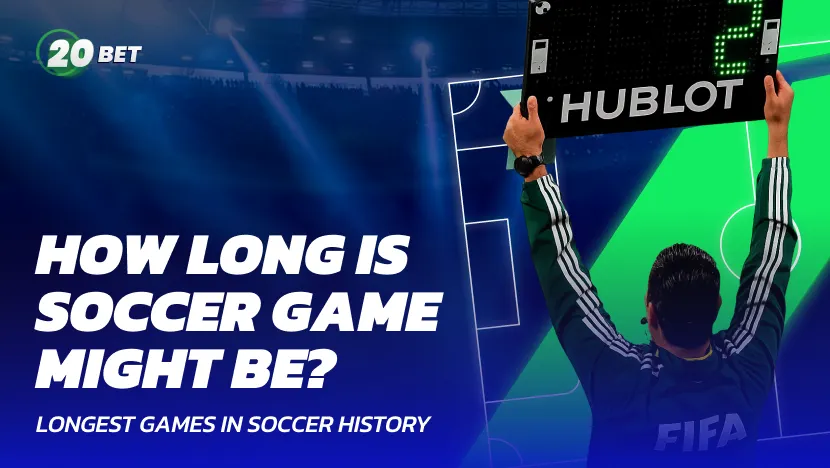
Time is an essential part of a soccer match. This has increasingly become a crucial part of the modern on-field and off-field discourse with the introduction of Video Assistant Referee (VAR) technology, which has placed the spotlight sharply on how long a soccer match is when played.
Deep dives by Total Football Analysis (TFA) and ESPN show that the duration of a soccer game has increased in the era of VAR. With lengthy reviews during matches, referees have the tools to determine the amount of time needed to be added on, which has led to the upsurge in longer matches than the traditional 90 minutes plus a few minutes of injury time
Even before the advent of VAR, historically, soccer matches’ durations have varied depending on the situations at hand and other factors, such as substitutions, inquiries and medical stoppages, time-wasting, disciplinary sanctions, goal celebrations, and the referee’s discretion. Here is an examination of some of the longest-duration matches in history.
Standard Duration of a Soccer Game
A typical professional soccer match comprises two equal halves of 45 minutes each, for a regulation time of 90 minutes. Between the two halves, there is a halftime interval, usually lasting 15 minutes, during which players rest.
The structure of the game is built around these two halves of 45 minutes, including managerial tactical interventions. Therefore, this timing has become a crucial part of the psychology of players and their coaches. This timing influences game management through the following factors:
- Tactical Periodization and Communication: The 45-minute block is often the only time players are beyond the direct and detailed reach of coaches. The 15-minute halftime break allows for managers to assert their influence on the match.
- Effective vs. Total Playing Time: Although the clock runs for 45 minutes, the ball is typically in play for only about 26-28 minutes per half.
- Fatigue and Performance Decay: Psychological and physical fatigue come into play, especially toward the end of either half.
- Momentum and Scorign Late: There is a common psychological belief in gaining momentum after scoring just before half time. There is also a spcyhologicla push toward the end of the match if it is poised and points still up for grabs.
- Time-Related Stress: Managers must manage the 90 minutes carefully to get the best out of the match.
The official playing time is managed by the referee, who adds stoppage time (also known as injury time or additional time) to the end of each half to account for delays, such as substitutions, celebrations, injuries, disciplinary measures (such as a card being shown), or VAR reviews.
The amount of stoppage time can vary immensely, from 1-2 minutes to sometimes 10-12 minutes or more in extreme cases, especially with recent IFAB/FIFA directives to increase actual playing time.
A summary of the standard duration of a soccer game, according to the Laws of the Game, primarily Law 7, is illustrated in the table below:
| Duration Aspect | Explanation |
| Two 45-Minute Halves | The soccer game length is divided into two equal halves. |
| Soccer Halftime Length | There is a 15-minute break between the two halves, allowing players to rest and regroup as long as it lasts. |
| Stoppage Time | The referee adds time at the end of each half to compensate for delays such as substitutions, injuries, and time-wasting. This means a half can be slightly longer than 45 minutes, a factor that is important for bettors to consider. |
| Extra Time | In knockout competitions, if the score is tied after 90 minutes, two additional 15-minute periods are played. |
| Penalty Shootout | If the score remains tied after extra time, a penalty shootout determines the winner. This does not add to the overall playing time but determines the final result. |
The average professional match today, including halftime and stoppage time, often lasts 100-105 minutes. For example, according to BBC, the average 2023/24 Premier League match lasted 101 minutes while a Serie A match in the same season lasted 101.4 minutes.
Record-Breaking Longest Official and Unofficial Matches
The standard rules of play can be suspended for extraordinary circumstances. The result of this curveout are incredibly long games that test the limits of the players involved.
Official Match Record – Stockport County vs Doncaster Rovers (England, 30 March 1946)
The longest professional and competitive football match in recorded history took place in 1946. It was a Division Three North Cup replay. According to the Guardian, on 30 March 1946, Stockport County hosted Doncaster Rovers in the second leg of a League III North Cup match.
The first game had finished 2-2, with the second one ending in the same scoreline. So they played extra time and, with no further goals having been scored, they continued, and continued. The details are as follows:
- Duration: The game lasted a stunning 203 minutes (3 hours and 23 minutes) of playing time, excluding halftimes and extra time breaks.
- Circumstance: The rules at the time stipulated that the game should be played until one team scored (sudden death or “next goal wins”), which was intended to prevent endless replays.
- Result: The match was eventually halted due to bad light and a thick fog that had settled over the ground, with the score still tied at 2-2. A replay was ordered, which Doncaster Rovers won 4-0. The “play to a finish” rule was soon abolished due to the controversy this caused.
Unlike modern tiebreakers, the “play to a finish” rule did not use penalty shootouts. Instead, it operated under a sudden-death format with no time limit:
- Initial Regulation: Teams played the standard 90 minutes.
- Standard Extra Time: If tied, they played two 10-minute periods of extra time.
- Unlimited Extension: If still tied after extra time, the match continued indefinitely until one team scored a “golden goal”.
Record Longest Marathon Game – 168 Hours (7 Days) by TSV Winterbach & TGIF‑EC Wallhalben (Germany, May 29 to June 5, 2019)
Teams from Germany hold a record for a 168-hour marathon game in 2019 according to the Guinness World Records. The record-setting event falls under the category of a marathon match for charity rather than professional competition.
The teams, SF Winterbach and TGIF-EC Wallhalben (both from Germany) set the Guinness World Record for the longest marathon playing football (soccer). Here’s what happened:
- Duration: The game was played continuously for 168 hours (seven full days).
- Circumstance: Two German amateur clubs, SF Winterbach and TGIF-EC Wallhalben, organized the event in 2019 to set a new world record. Each team used a large roster of players (19 per side) who rotated on and off the field.
- Result: SF Winterbach 1,797 – TGIF-EC Wallhalben 1,830. The focus was on endurance and participation, not a typical competitive result.
Other Notable Long Matches
- Dostlukspor Bottrop vs BW Wesel: An amateur match where the referee added an incredible 28 minutes of stoppage time due to persistent time-wasting.
- AS Adema vs SO l’Emyrne: While this is not a long match, this 2002 Malagasy league game holds the record for the highest score (149-0) due to a protest where the losing team repeatedly scored own goals. This demonstrates how extraordinary circumstances can impact a game’s outcome in unexpected ways.
What These Long Matches Tell Us About Game Duration
These extreme examples highlight that while the 90-minute figure is the foundation of the sport, the actual duration can be highly variable. The professional record shows that rules and conditions (like daylight) can have a dramatic extending effect on a single tie-breaking match.
The marathon games, meanwhile, showcase human limits and the organizational effort required for prolonged continuous play. The main takeaway is that a match does not always end when the clock hits 90 minutes, which is not exactly consistent with Sepp Herberger’s description of the game, “The ball is round and the game lasts 90 minutes.”
In the age of VAR reviews, added time goes up with match officials taking more time to review video evidence. During the 2022 Qatar World Cup, the England vs. Iran match saw 24 added minutes, and the game played for 27 minutes, playing for 117 minutes total. However, this was mainly due to a severe injury stoppage.
A similar case was witnessed in a Premier League fixture involving Fulham and Sheffield United, on October 8th, 2023, that saw play go on for 24 added minutes. A serious injury to defender Chris Basham saw play stopped for a long time until he was stretchered off the pitch.
Implications for Players, Coaches, and Bettors
The potential for extended playing time has significant implications:
- Players: Overtime and marathon games impose significant physical demands on players. This leads to increased fatigue and higher risk of injury. Coaches must manage their squad depth and conditioning to prepare for these scenarios.
- Coaches: Strategic decisions, such as substitutions and managing the tempo of the game, become crucial when the match goes beyond the standard 90 minutes.
- Bettors: The possibility of extra periods changes the dynamics of betting. A wager on the match result usually only covers the 90-minutes plus stoppage time. However, bets like “to qualify” or “correct score” might include extra time. Understanding these rules is vital for making informed betting choices.
Summary
The standard soccer game length is 90 minutes plus stoppage time. In knockout competitions, this can extend to over two hours with extra time and penalties.
Record-breaking official games have lasted over three hours, while exhibition marathon matches can go on for days. The actual duration is a dynamic aspect of the sport that varies based on the rules, competition format, and on-field events.
A regular soccer game at the professional level consists of two 45-minute halves for a total of 90 minutes of regulation time. It varies based on the circumstances of the match. The amount of stoppage time is at the referee’s discretion. It is usually between 2-5 minutes per half, but in recent years, especially in major tournaments like the 2022 World Cup, it has often been 10+ minutes to account for all delays. In league competitions, a tie result stands. In cup or tournament knockout matches, the game typically goes into two 15-minute extra time periods, followed by a penalty shootout if necessary (if the game is still a tie). The longest professional and competitive football match was between Stockport County and Doncaster Rovers in 1946, lasting 203 minutes (3 hours and 23 minutes) before being stopped due to darkness. Explore the most iconic yellow and red cards in soccer history, from controversial ejections to game-changing moments. Understand the evolution of soccer discipline and the impact of cards on tactics and betting. From El Rock del Mundial to Hayya Hayya, relive the most iconic World Cup songs and anthems. Discover the best, the worst, and the impact of music on the world's biggest soccer event. Discover how MLS players like Lionel Messi and David Beckham are investing their millions. Learn about their strategies, from real estate and startups to team ownership and franchise deals, to build lasting wealth beyond their playing careers. The 2022/2023 Premier League season has entered its business end now. Read our article to find out more! Subscription successful! Stay tuned for our exciting news and offers. We’re sorry, something went wrong. Please try again later.FAQs
How long is a regular soccer game?
How much stoppage time is usually added?
What happens if the match is tied after 90 minutes?
What is the longest professional soccer match on record?

Related Posts
See All
From Warnings to Ejections: Most Iconic Cards in Soccer
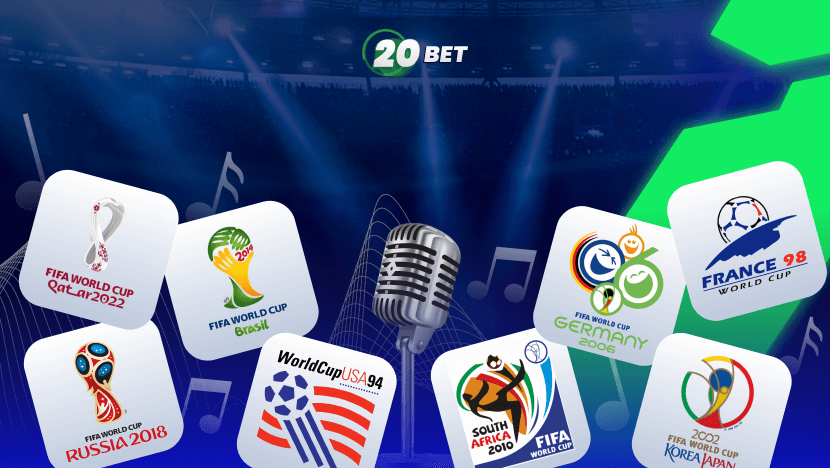
FIFA World Cup Songs and Anthems
How MLS Stars Are Investing Their Millions: From Restaurants to Real Estate
Who Will Win The Premier League 2022-2023? Premier League Favorites