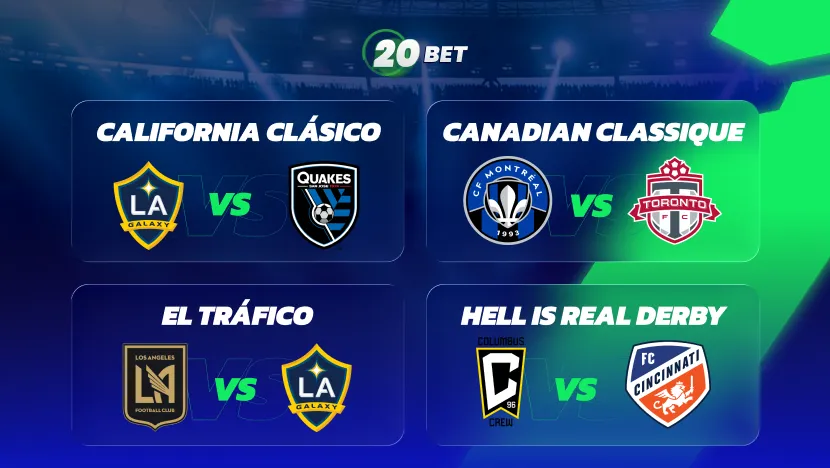
MLS rivalry matches don’t just feel different — they often trade differently. The crowd is louder, the edges are sharper, and markets get flooded with opinion money early. If you’ve ever watched a calm match turn feral after one tackle, you already understand the problem: derbies compress the margin for error.
We treat derby matches as their own category. Not because they’re “random,” but because the inputs change: intensity, discipline risk, and public betting pressure all rise at the same time.
Understanding MLS Derby Games & Rivalries
Rivalries in MLS come in a few flavors. Some are geographic and cultural (same city, same region, same fans). Others are built over time — playoff scars, repeated chaos, signature moments, and a media narrative that never really dies.
For betting, the key point is simple: a rivalry can change behavior. It can push teams to press harder, foul earlier, argue more, and gamble in the second half. That doesn’t guarantee goals or cards, but it does mean your regular-season baseline is less reliable.
What Makes a Match a “Derby” in MLS
A derby in MLS usually means a local or regional rivalry, but the label is used pretty broadly. If a matchup has real bragging rights, a charged atmosphere, and a history that keeps pulling both teams back into the same storyline, it’s commonly treated as an MLS derby, even if it’s not strictly city vs city.
Historical MLS Derbies: From El Tráfico to Hell Is Real
These are some of the famous historical rivalries that show up every season and keep growing.
El Tráfico (LA Galaxy vs LAFC)
This rivalry tends to trade like a high-emotion, high-tempo game, where one big moment (goal, flashpoint, early yellow) can flip the tempo fast. It’s also the kind of matchup that attracts heavy public action, which can push prices toward the “fun side” (especially goals-related angles) earlier than you’d see in a normal MLS week.
If you want a modern marker for how big this fixture has become, the 82,110 crowd at the Rose Bowl for Galaxy–LAFC (played July 4, 2023) shows the scale of attention and liquidity it can pull.
Hell Is Real (FC Cincinnati vs Columbus Crew)
Hell Is Real often plays like a derby where game state matters more than form: teams can look controlled, then suddenly get emotional, go direct, and start trading chances. The useful lens here is momentum management — who settles after conceding, who chases too early, and which midfield loses shape first.
For example, on May 20, 2023, Cincinnati beat Columbus 3–2 after surrendering a two-goal lead, then scoring again to win. That match captured the rivalry perfectly: calm → swing → chaos.
Hudson River Derby (New York City FC vs New York Red Bulls)
This derby is less about romance and more about identity clashes: one side trying to play through pressure, the other trying to win territory, second balls, and transitions. When it turns one-way, it usually looks like forced turnovers and rushed buildup, not slow possession.
The Red Bulls’ 7–0 win (May 21, 2016) is tied for the highest margin of victory in MLS history, which is why it’s still referenced when people talk about this rivalry “breaking” a game.
Cascadia Cup (Seattle Sounders vs Portland Timbers vs Vancouver Whitecaps)
Cascadia games are often decided by late execution: intensity stays high, legs go, and the match can open up sharply after the 70th minute. Instead of treating it as random, treat it as a spot where second-half volatility is simply more common than your baseline model expects.
A clean recent example came on April 15, 2023, when Portland beat Seattle 4–1, scoring four goals in the final 19 minutes — a classic Cascadia shift from tight to suddenly open game.
Atlantic Cup (D.C. United vs New York Red Bulls)
This rivalry can swing between grindy chess and set-piece chaos, so the best read is often structural: who can defend restarts, who gets pinned, and who forces the other into low-percentage clearances. When the tempo spikes, it’s usually because the match turns into broken phases rather than sustained control.
A reminder of how explosive it can be came on September 23, 2023, when D.C. United and the Red Bulls combined for eight goals in a 5–3 match. Despite Benteke scoring a hat trick, New York still won.
Rocky Mountain Cup (Real Salt Lake vs Colorado Rapids)
This is a derby where fatigue and emotion show up late, and it’s one of the better MLS examples of “don’t assume the last 15 minutes will look like the first 60.” If the match stays intense (instead of cooling), late defensive decisions get sloppy, and transitions multiply.
For instance, on May 18, 2024, Real Salt Lake scored three goals after the 84th minute to win 5–3.
How Rivalries Influence Match Intensity and Player Performance
Rivalry games change behavior. Players take more risks, talk more, and react faster. That can raise intensity, but it can also lower precision.
For example, the Hudson River Derby has produced 877 fouls across 30 meetings (29.2 per match) and 12 red cards (0.40 per match).
For comparison, league-wide Opta team totals from the 2025 MLS regular season show 13,111 fouls committed across 540 matches, which averages out to about 24.3 fouls per match (13,111 ÷ 540 matches), and 88 red cards or around 0.16 per match (88 ÷ 540).
Impact of Derbies on Betting Lines and Odds
Derbies attract more “emotion betting,” so odds often shift faster and get a little worse for the side most fans are backing. Books know lots of people will bet the rivalry favorite or the “fun” angle (like goals), so they adjust the price to protect themselves.
You can see how tight rivalry pricing gets in Portland Timbers vs Seattle Sounders (Cascadia), which opened around POR +145 / SEA +154 / Draw +260 for their match on May 17, 2025, basically saying that either team can win. In a regular week, one of those teams is often priced as a clearer favorite, but derby games get priced closer because the market expects a messier, more unpredictable match.
Betting Strategies for Derby Matches in MLS
If you want derby betting tips that actually hold up, start with structure. Do not try to “feel” a rivalry into a bet. Use a plan that respects the extra noise.
A simple approach a derby betting expert would follow:
- Goal-chaos rivalries: El Tráfico has averaged 4.35 goals per game across 26 all-time meetings, compared to the MLS average of 3.02 goals per match in 2025. As a result, goals markets are often more viable in this matchup than in a standard week.
- 4+ goal spike pattern: two of the last six Hell Is Real meetings have produced four or more goals (4–2 on July 12, 2025; 4–0 on November 2, 2025). That’s still enough to justify live overs only when the tempo is truly wild early, but it’s no longer a “default overs” rivalry based on the most recent sample.
These are derby day betting tips, not guarantees. The point is to reduce bad bets, not to force action.
Risk Factors & Volatility During Derby Games
Derbies add risk you do not always see in normal fixtures. The match can be “normal” for 60 minutes, then explode. That is why derby betting needs tighter rules.
Main risk factors to respect:
- Unpredictability: emotional matches create weird game states.
- Discipline issues: one moment of hostility can lead to a red and break every pregame read.
- Fatigue spikes: higher intensity runs drain legs and reduce late execution.
- Overreaction traps: one early chance does not mean the whole match will stay open.
When the market is jumpy, protect your bankroll. Treat volatility like a cost.
Responsible Gambling
Quick reminder: derby previews are for information and entertainment. Your bankroll comes first.
- Set a weekly budget and a fixed unit size, and do not increase stakes after losses.
- Use deposit, loss, and time limits or time-outs in your betting app before busy matchdays.
- Keep a simple bet log and stop if you start chasing.
- If it feels stressful, take a cooling-off break or a self-exclusion period.
Need help? US: 1-800-GAMBLER. Canada: ConnexOntario 1-866-531-2600; Gambling Support BC 1-888-795-6111; Québec: 1-800-461-0140. For mental-health crisis support, dial 9-8-8.
Keep it fun, stake responsibly, and follow local laws.
FAQ
What defines a “derby” in MLS?
An MLS derby is a matchup with extra local or cultural meaning, repeated tension, and real bragging rights. It can be city-based, regional, or built from history and big moments.
Why do derby games often have different odds than regular matches?
Because rivalries change behavior and betting action. The market prices the extra intensity, the higher chance of chaos, and the heavier public money that follows big rivalry games.
Are derby games more unpredictable than standard fixtures?
Often, yes. Rivalry pressure can create mistakes, cards, and emotional swings that are less common in normal fixtures. That raises unpredictability and volatility, especially in the second half.
How should I adjust my betting strategy for a derby match?
Be more selective. Set your price, limit your stake, and use live betting only after you have seen the real tempo and territory. Keep your plan tight, and do not chase.


Related Posts
See All-
 20/10/25
Premier League Betting for 2025-2026 Season: What’s New, and What to Look For?
Get sharper Premier League predictions for 2025/26. Full preview covering title contenders, key transfers, new rules, breakout players, and actionable betting markets from 20Bet expert.
-
 14/01/26
Champions League 2025–26: Teams Most Likely To Score Early
Which UCL teams strike first? Explore early goal stats for Man City, Bayern, and Real Madrid. Data-backed insights on first-half scoring trends and win probabilities.
-
 20/01/26
Europa League 2025–26: Clubs With the Best Home Advantage
Which clubs dominate at home in the 2025–26 Europa League? See how Porto, Aston Villa, and PAOK use home advantage to fuel their knockout stage predictions.
-
 20/01/26
Top 7 Most Consistent Goalscorers in 2025–26: Stats, Odds, Predictability
Analyze the most consistent strikers in Europe. From Haaland's efficiency to Ferran Torres' rise, we break down the data to find the best goalscoring value.
Choose a language Done Subscription successful! Stay tuned for our exciting news and offers.
Error We’re sorry, something went wrong. Please try again later.