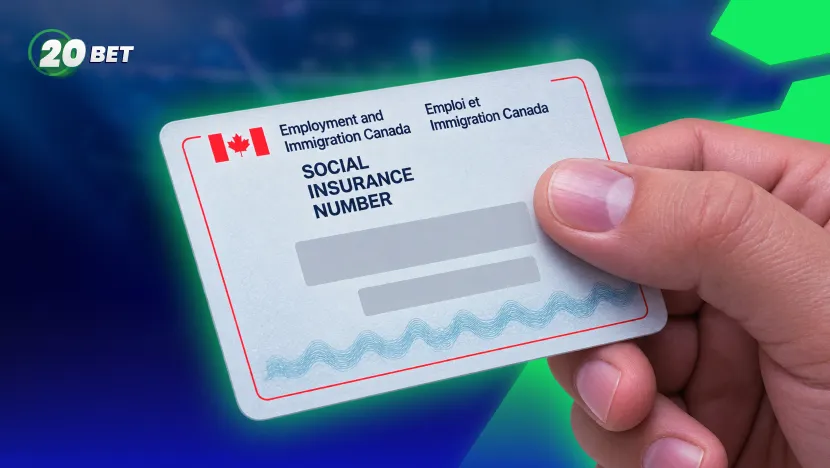
If you are new to online betting, verifications throw a lot at you at once. A passport. Proof of address. A photo of the card you paid with. Then somewhere in that pile you spot a request for your Social Insurance Number, and there is no obvious way to tell whether that one is normal.
It is not. Your SIN is the number the government uses to track your income, and that is the whole job. 20Bet does not need it, and neither does any other sportsbook.
Here is what the platform does ask for during 20Bet registration, and what to do when someone pushes for more.
Why 20Bet Requests Identity Verification
Start with the reason behind the paperwork. Every operator runs Know Your Customer (KYC) checks before releasing a withdrawal. Verification confirms the account belongs to the person who opened it, satisfies the anti-money-laundering compliance duties its regulator imposes, and gives support a way back into your profile if you lose access.
None of it needs a tax number. During 20Bet sports registration, the platform checks three facts: you exist, you live where you claim, and the payment method belongs to you.
Does 20Bet Ever Require Your Social Insurance Number (SIN)?
No, and the reasoning applies to almost every gambling site you will meet. The 20Bet sportsbook runs by Lumora Digital Lt. (license Anjouan Gaming Board, license number ALSI-202505033-FI2). It pays out winnings, yet it never pays you income the way an employer or a bank does.
Canadian legislation obliges a company to collect a SIN only when it reports income to the CRA: banks for interest and dividends, digital platforms for sellers earning through goods, rentals or rideshare. A sportsbook fits neither category.
So when an agent asks for your SIN, you are looking at company policy. Decline politely and offer a second photo ID. Under PIPEDA, no organisation here can withhold a service because you refused a SIN the law does not require.
When a SIN Is Appropriate to Share in Canada
Refusing depends on knowing where the line sits, so let us draw it clearly.
What Is a SIN, and Who Can Legally Ask for It?
Your SIN is a confidential nine-digit file number for income reporting and government programs. It carries no photo, no signature and no security features. Service Canada stopped issuing physical cards in 2014 for that reason.
Four situations call for it:
- Your employer within three days of your first shift
- Banks for accounts earning interest
- RA at tax time
- Programs such as EI, CPP and student loans
Search ‘SIN Canada’ on canada.ca, and that list barely grows. The SIN that Canada issues you stays with you for life, so treat every other request as optional.
Update Your Own SIN Record
Accuracy runs both ways. A legal name change calls for a SIN update within 60 days.
Temporary residents follow a different rule: once a renewed work or study permit arrives, you re-apply to the SIN program to update the expiry date on your record, so the two documents match.
To update your SIN record online, apply directly through Service Canada’s own application page. Third-party sites charging a fee feed a documented phishing pipeline.
What Documents 20Bet Usually Accept for KYC
With the legal boundary settled, here is the list the platform actually works from:
- Identity: a valid passport, driver’s licence or national ID card, unexpired and fully visible.
- Proof of address: a utility bill or bank statement no older than the past three months showing your name and municipality.
- Payment method: a screenshot of the card or e-wallet, registered to the account holder.
- Selfie with ID: where requested, with face and document both legible.
Look at what never appears. A hydro bill proves residency, a photo page proves identity, and neither goes near a tax reference.
How 20Bet Verifies Your Identity Without a SIN
The checks behind the screen are documentary and technical. Automated systems read each upload, compare the name and address against your profile, then flag anything that disagrees. Where biometrics apply, a liveness selfie gets matched to the photo on your ID.
Login authentication adds a second layer: a one-time token by SMS or email, plus device and location signals. Together they answer the only question that matters at cash-out. Is the person withdrawing the same person who signed up?
Why Sharing Your SIN Can Be Risky
Your SIN opens the door to your credit file. Pair it with a date of birth and an address, and someone can apply for cards or sign a lease in your name. Canada’s privacy commissioner has warned about this for years, and identity fraud cases prove it monthly.
Gambling platforms also sit high on the target list for data theft. A leaked email costs you an afternoon of password resets. A leaked SIN follows you for decades, since Service Canada replaces one only on proof of misuse.
How to Protect Your Personal Information During Verification
Good habits here take two minutes. Upload from a device you own, on a network you trust. Read the full domain in your browser before attaching a file, since encryption in transit protects nothing on a cloned page.
Update your operating system, firewall and security software on a schedule, because ordinary cybersecurity habits stop most credential theft at the door. Send files through the account’s upload form. Email and live chat scatter copies across servers you cannot control.
What to Do If 20Bet Requests Additional Documents
Extra requests happen, and most are routine. A selfie with ID or a source-of-funds confirmation appears when a deposit pattern looks unusual.
Ask three questions first: what exactly do you need, why, and how long will you store it? A second photo ID or a fresh utility bill answers almost every legitimate request. If an agent still insists on a tax number, escalate and put the exchange in writing.
Common Verification Mistakes That Delay Approval
Most delays trace back to small errors on your side. A first name shortened on one file and spelled in full on another. An expired ID. A photo cropped until the edges vanish. A screenshot showing a partner’s card.
Blurry images trigger a second review. Edited ones trigger a third. Treat onboarding as a short checklist, work through it once with care, and approval usually lands within 48 hours.
What to Do If You Think You’ve Shared Your SIN Unnecessarily
Suppose you already sent it, here or elsewhere. Move now, while your file is still clean:
- Ask the company in writing to delete the number from its records.
- Order your credit report from Equifax (1-800-465-7166) and TransUnion (1-800-663-9980), then ask each about a fraud alert.
- Report the exposure to the Canadian Anti-Fraud Centre at 1-888-495-8501.
- Tell your bank and creditors, and read your statements for accounts you never opened.
If the company refuses, the Office of the Privacy Commissioner of Canada takes complaints at 1-800-282-1376. Twelve months of monitoring beats chasing a replacement SIN.
Best Practices for Safe Online Betting Verification in Canada
Give the minimum that satisfies the check. Hold one clean, current set of documents so your details agree everywhere. Read the retention policy before you upload, set a unique password, and switch on two-factor sign-in.
Then hold on to the asymmetry at the centre of all this. You can close a betting account today and open another tomorrow. Your SIN travels with you for life.
Responsible Gambling
Betting should be entertainment, not a way to make money. Gambling can be addictive—only bet what you can afford to lose, and never chase your losses. Set deposit, loss, and time limits before you play, and take regular breaks.
If gambling stops being fun or starts affecting your finances, relationships, or wellbeing, seek help immediately.
Support available across Canada:
- Responsible Gambling Council: responsiblegambling.org (national resource center)
- British Columbia: Call 1-888-795-6111 (24/7)
- Alberta: Call 1-866-332-2322 (24/7)
- Quebec: Call 1-800-461-0140 (24/7, bilingual)
- Saskatchewan: Call 1-800-306-6789 (24/7)
- Manitoba: Call 1-800-463-1554 (24/7)
- Atlantic provinces: Call 1-800-461-1234 (NB), 1-888-429-8167 (NS), 1-855-255-4255 (PE), 1-888-899-4357 (NL)
- Additional support: Gambling Therapy (gamblingtherapy.org), Gamblers Anonymous (gamblersanonymous.org)
- 988 Suicide Crisis Helpline: Call or text 988
20Bet provides responsible gambling tools in your account settings, including deposit limits, loss limits, time limits, cool-off periods, and self-exclusion. Use them.
Age restrictions: You must be 19 or older to gamble in British Columbia, Saskatchewan, and Atlantic provinces. You must be 18 or older in Alberta, Manitoba, and Quebec. Underage gambling is illegal.
20Bet is licensed and regulated by the Kahnawake Gaming Commission. For more information about responsible gambling practices and support resources, visit the Responsible Gambling section on 20Bet.

FAQ
Does 20Bet require my SIN to verify my account?
No. Its KYC list covers identity, address, payment method and sometimes a selfie. Nothing in Canadian law obliges an offshore platform to collect a tax number.
Which documents can I use instead of my SIN?
A passport, provincial driver’s licence or national ID card confirms who you are. A utility bill or bank statement under three months old confirms where you live.
Is it safe to upload identity documents to 20Bet?
Reasonably safe, once you use the in-account upload form over a connection and domain you have checked yourself. No transfer carries zero risk, so send only what the platform asks for.
What should I do if I accidentally shared my SIN with an online betting site?
Request deletion in writing, watch both credit bureaus for activity you do not recognise, and report the exposure to the Canadian Anti-Fraud Centre.


Related Posts
See All-
 11/03/26
20Bet Withdrawal Options Explained: Fastest & Safest Payout Methods
Step-by-step guide to 20Bet payouts. Find out why your withdrawal is pending, how to pass KYC verification, and the minimum/maximum withdrawal limits for 2026.
-
 16/03/26
20Bet Casino New Releases: Best Games to Try Right Now
Read about the latest 20Bet casino games, including high-RTP slots like Dr. Luck (98.5%) and new live dealer tables. Discover trending titles and expert gameplay tips.
-
 19/03/26
20Bet VIP Login Guide: Get More From Your Loyalty & VIP Rewards
Stop missing out on 20Bet loyalty points. See how to unlock 30 VIP levels automatically, get 5x wagering on sports bonuses, and reach the $100k grand prize.
-
 18/09/26
Are 20Bet Winnings Taxable in Canada? Recreational vs. Professional Gambler Rules Explained
Are 20Bet winnings taxable in Canada? Learn how the CRA differentiates recreational gamblers from professionals, tax-free windfalls, and reporting rules.
Choose a language Done Subscription successful! Stay tuned for our exciting news and offers.
Error We’re sorry, something went wrong. Please try again later.